
Running paid ads in the United States is not the same game it was five years ago. Costs per click have climbed across nearly every major platform, shoppers now research across Google, Amazon, and social feeds before buying anything, and a single misconfigured campaign can burn through a month’s budget in days. For a small business owner or marketing lead trying to figure out what “PPC management” actually means — and whether to do it yourself, hire a freelancer, or bring in an agency — the amount of conflicting advice online makes the decision harder, not easier.
This guide breaks down what professional PPC management for the US market actually involves: the platforms worth your budget, how spend should typically be allocated, what a competent manager does week to week, and the mistakes that quietly drain ad accounts. It is written for beginners and small business owners, not for agencies pitching each other, so the goal throughout is practical clarity rather than jargon.
Quick Answer: What PPC Management for the US Market Actually Involves
PPC management for the US market means researching and selecting the right paid advertising platforms (typically Google Ads, Amazon Ads, Meta Ads, and sometimes Walmart Connect), setting up campaigns with accurate targeting and bidding, writing and testing ad creative, monitoring performance daily or weekly, and continuously adjusting budgets and keywords based on metrics like ROAS, ACOS, and cost per acquisition. It can be handled in-house, by a freelancer, or by an agency, and the right choice depends mainly on budget size, available time, and how quickly the business needs results.
What Is PPC Management?
Pay-per-click (PPC) advertising is a model where an advertiser pays each time someone clicks their ad, rather than paying a flat fee for placement. PPC management is the ongoing work of running those campaigns effectively: choosing keywords or audiences, setting bids and budgets, writing ad copy, building landing pages that convert, and reviewing performance data to decide what to change.
It is not a one-time setup. A campaign that performs well in its first week can quietly become unprofitable a month later as competitors adjust their bids, seasonal demand shifts, or a product goes out of stock. Management is the difference between a campaign that was launched and a campaign that is actively being improved.
In practice, PPC management usually covers four ongoing responsibilities: strategy (which platforms and campaign types to use), execution (building and launching campaigns correctly), optimization (bid, budget, and keyword adjustments based on data), and reporting (translating account activity into decisions the business owner can act on).
It’s worth separating “PPC management” from “PPC setup,” since the two are often sold or discussed as if they were the same thing. Setup is largely a one-time project: choosing a campaign structure, entering initial keywords or audiences, and launching. Management is the recurring work that happens after launch — and for most accounts, the majority of the value comes from that ongoing work rather than from how the account was initially configured. A well-set-up account that nobody reviews for three months will still drift toward inefficiency.
Why PPC Management for the US Market Is Different
The US is one of the most competitive advertising markets in the world, which changes the calculus in a few specific ways.
- Higher CPCs in competitive niches: legal, insurance, finance, and many e-commerce categories routinely see cost-per-click figures well above the global average, which makes wasted clicks more expensive.
- Platform fragmentation: US shoppers split their research and buying across Google, Amazon, and social platforms, so single-platform strategies often leave demand uncaptured.
- Seasonality is sharper: Q4 holiday demand, Prime-adjacent shopping events, and back-to-school periods create predictable spikes in both competition and CPCs.
- Regulatory and platform policy sensitivity: certain categories (health, finance, supplements) face stricter ad review, and claims need to hold up to FTC advertising guidance regardless of platform.
None of this means PPC is riskier in the US — it means the margin for error in targeting and budget allocation is smaller. A campaign that would coast along in a lower-competition market needs active management to stay profitable here.
There is also a payments and purchase-behavior dimension that often gets overlooked. US shoppers are heavily accustomed to fast shipping expectations set by Amazon Prime, free-return policies, and visible customer reviews before clicking “buy.” An ad that wins the click but sends someone to a page without clear shipping timelines, return policy, or social proof tends to underperform regardless of how well the targeting was set up. Management, in this sense, is not purely a media-buying discipline — it overlaps with conversion rate optimization on whatever page the ad ultimately points to.
Which PPC Platforms Matter for US Businesses
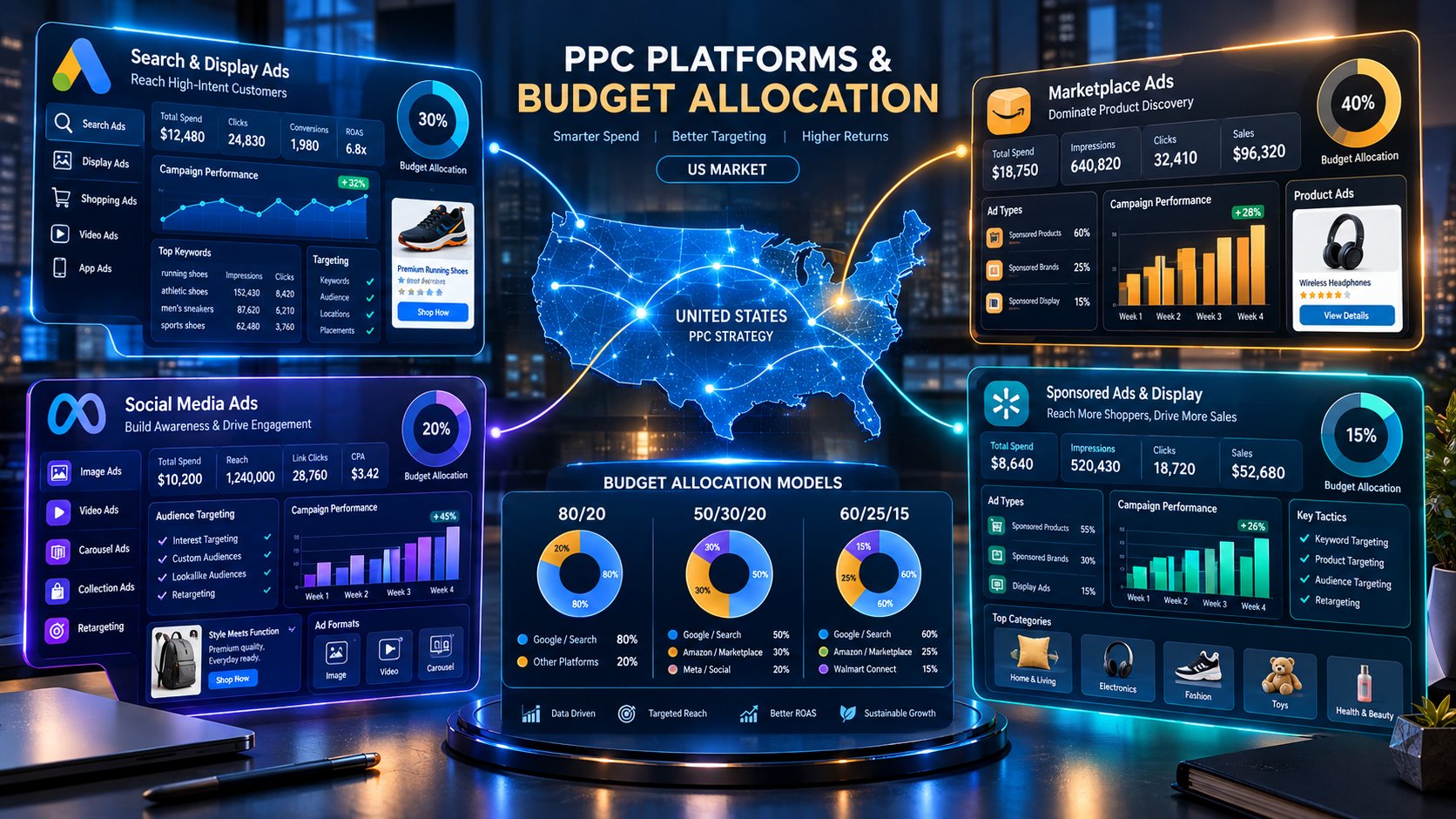
Most US small businesses do not need to be on every platform. The right mix depends on the business model, but these four cover the vast majority of relevant paid demand.
Google Ads (Search & Shopping)
Google Ads captures high-intent search demand — people actively typing what they want. Search campaigns work well for service businesses and anyone selling something with a clear, searchable name. Shopping campaigns are typically the stronger fit for e-commerce, since they show the product image, price, and store directly in results. For most businesses without an existing presence on Amazon, Google is the natural starting platform.
Amazon Ads
For sellers already on Amazon, Amazon Ads (Sponsored Products, Sponsored Brands, Sponsored Display) matters as much as, or more than, Google. Amazon shoppers are typically closer to a purchase decision than a general web searcher, and ranking within Amazon’s own search results depends heavily on a combination of organic listing quality and ad visibility. A listing with weak PPC support can lose ground to competitors even if the product itself is stronger.
Meta Ads (Facebook & Instagram)
Meta Ads work differently — they interrupt rather than respond to intent, which makes them well suited to demand generation, retargeting past website visitors, and reaching audiences before they start searching. For brands with strong visuals or a story to tell, Meta often produces a lower cost per acquisition on retargeting audiences than on cold prospecting, so it is common to allocate more budget there than to cold Meta traffic.
Walmart Connect
Walmart Connect is smaller in scale than Amazon Ads but has grown quickly, particularly for consumer packaged goods and household categories where Walmart’s customer base overlaps heavily with the product’s target buyer. It is generally not a starting platform — it makes sense once a business already sells on Walmart Marketplace and wants to compete for visibility there the same way it does on Amazon.
A useful way to think about the four platforms together: Google and Meta largely bring new demand into a business’s own funnel, while Amazon Ads and Walmart Connect largely compete for demand that is already happening inside someone else’s marketplace. Both are legitimate strategies, but they require different creative, different keyword logic, and different success metrics — which is why treating all four platforms as interchangeable “PPC” is one of the more common strategic mistakes small businesses make when they first expand beyond a single channel.
The Core Components of Professional PPC Management
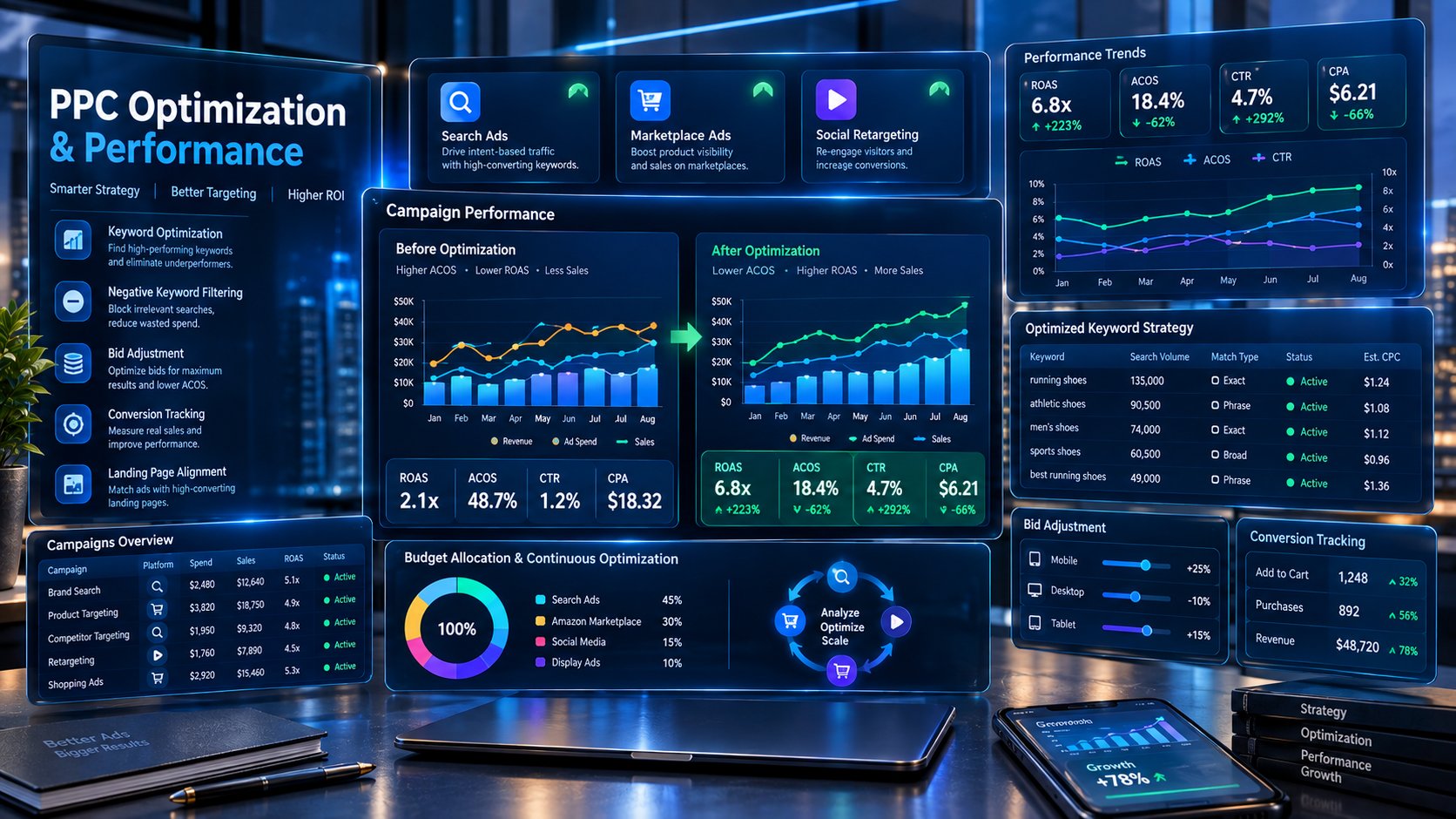
Regardless of platform, competent PPC management includes the same core components. What separates strong management from weak management is usually the consistency of the second half of this list — the ongoing optimization work — rather than the initial setup.
- Keyword and audience research: identifying what buyers actually search for or which audiences convert, not just what seems relevant
- Campaign structure: organizing campaigns and ad groups so budget and bidding can be controlled precisely, rather than lumping unrelated products or services together
- Bid and budget management: adjusting bids based on performance data rather than “set and forget,” and reallocating budget toward what is working
- Ad copy and creative testing: running multiple ad variations to find what earns clicks and conversions, then retiring the weaker versions
- Negative keyword management: actively excluding irrelevant search terms that waste spend without producing sales
- Landing page alignment: making sure the page someone lands on actually matches what the ad promised — a common and easily fixed source of wasted spend
- Reporting and analysis: reviewing ROAS, ACOS, CPA, and conversion data on a regular cadence and making changes based on it, not guesswork
Of these, negative keyword management and reporting are the two most commonly neglected once initial excitement about a new campaign wears off. Both are unglamorous, ongoing tasks rather than one-time setup steps, which is exactly why accounts that go unmanaged for a few months tend to drift toward wasted spend even when nothing about the campaign itself was technically broken at launch.
How to Budget for PPC in the US Market
There is no universal “right” PPC budget — it depends on margins, average order value, and competitiveness of the category. That said, a simple starting framework helps avoid two common errors: spreading budget too thin across platforms, or putting everything into one channel before it has proven itself.
| Business Stage | Suggested Starting Split | Reasoning |
| New to PPC, service business | 80% Google Search, 20% testing (Meta retargeting) | Search captures existing demand while limited budget avoids risky cold prospecting |
| E-commerce, new to Amazon | 50% Amazon Ads, 30% Google Shopping, 20% Meta retargeting | Balances marketplace visibility with off-Amazon demand capture |
| Established Amazon seller | 60% Amazon Ads, 25% Google Shopping, 15% Meta retargeting | Protects Amazon rank while diversifying traffic sources |
| Multi-marketplace seller (Amazon + Walmart) | 50% Amazon Ads, 20% Walmart Connect, 20% Google Shopping, 10% Meta | Reflects where the business already has proven marketplace presence |
A practical rule for beginners: hold back roughly 20% of any new platform’s budget as a testing allowance for the first 60–90 days rather than committing everything to a single campaign structure. Early data is noisy, and a smaller test budget limits the cost of getting the initial targeting wrong.
Budgets also need a review rhythm, not just an initial split. A common approach is a light weekly check (pausing anything clearly underperforming, adjusting daily caps) paired with a deeper monthly reallocation across platforms based on which one is actually producing the best ROAS or ACOS for the spend it received. Businesses that set a budget once at the start of the quarter and revisit it only when spend runs out tend to keep funding whatever campaign launched first, rather than whatever campaign is currently performing best.
In-House vs Freelancer vs Agency: Choosing PPC Management
This decision usually comes down to three factors: monthly ad spend, available internal time, and how quickly results are needed.
In-House Management
Makes sense when someone on the team has the time and willingness to learn the platforms properly, ad spend is modest, and the business can tolerate a learning curve. The main risk is opportunity cost — hours spent learning platform mechanics are hours not spent on other parts of the business.
Freelancer Management
A reasonable middle ground for businesses with moderate, steady ad spend and a fairly simple account structure. Freelancers are typically more affordable than agencies but have less bandwidth for extensive testing across multiple platforms simultaneously, and quality varies more widely than with an established agency.
Agency Management
Generally the better fit once a business is running PPC across multiple platforms, ad spend is significant enough that small optimization gains translate into real dollars, or the team simply does not have time to manage it well internally. The trade-off is cost and, in some cases, less day-to-day visibility unless the agency provides clear, regular reporting.
There is no single correct answer here — a $2,000/month single-platform account and a $50,000/month multi-platform account are different problems with different appropriate solutions. A reasonable way to decide is to estimate the number of hours a proper job would take each week (research, bid adjustments, creative testing, reporting) and compare that honestly against who on the team actually has that time free — rather than assuming any option is automatically cheaper once internal labor cost is factored in.
Key PPC KPIs and Metrics to Track
Whoever manages the account, these are the metrics that actually indicate whether spend is working, rather than vanity numbers like impressions alone.
- ROAS (Return on Ad Spend): revenue generated per dollar spent on ads — the core profitability metric for e-commerce
- ACOS (Advertising Cost of Sale): ad spend as a percentage of sales generated, used heavily on Amazon; lower generally means more efficient spend
- CTR (Click-Through Rate): the percentage of people who see an ad and click it, an early signal of ad relevance
- CPA (Cost Per Acquisition): what it actually costs to generate one sale or lead, which should be compared against margin, not judged in isolation
- Quality Score (Google Ads): Google’s assessment of ad relevance and landing page experience, which directly affects cost per click
A campaign can have a high CTR and still be unprofitable, or a low CTR and still be efficient — no single metric tells the full story on its own. Competent management looks at these together, in the context of margin, not as isolated targets.
Common PPC Mistakes That Waste Ad Spend
A typical mistake is under-managing negative keywords, which lets irrelevant searches quietly consume budget for months without anyone noticing. Others show up just as often across US accounts of every size.
- Broad-matching keywords without negative keyword lists, leading to spend on unrelated searches
- Sending ad clicks to a homepage instead of a dedicated landing page matching the ad’s offer
- Setting a budget once and never revisiting it, even as seasonality or competition changes
- Judging performance too early — most campaigns need at least two to three weeks of real data before conclusions are reliable
- Running the same ad copy indefinitely instead of testing variations
- Ignoring Amazon organic listing quality while increasing ad spend, which raises ACOS without improving actual conversion rate
- Spreading a small budget across too many platforms at once instead of proving out one channel first
A related and often costlier mistake shows up specifically on Amazon: increasing ad spend to compensate for a weak organic listing, rather than fixing the listing itself. Ads can push traffic to a product page, but if the images, bullet points, or pricing aren’t converting that traffic well, higher ad spend simply produces a higher ACOS for the same number of sales. In practice, listing optimization and PPC management tend to work best as a paired effort rather than two separate projects.
Practical Scenarios: What PPC Management Looks Like in Practice
A local service business with a $1,500/month budget typically starts with a single, tightly scoped Google Search campaign around its core service and city, with a simple call-tracking landing page. The first month is mostly about eliminating irrelevant search terms and confirming which keywords actually convert into calls.
An e-commerce brand newly launching on Amazon commonly runs Sponsored Products campaigns aimed at its own product’s exact keywords alongside a small allocation toward competitor ASIN targeting, while simultaneously fixing listing images and bullet points — since ad clicks that land on a weak listing convert poorly regardless of targeting quality.
A brand already spending significantly on Amazon and considering Walmart Connect usually treats the first 60 days there as a controlled test rather than a full rollout, since Walmart’s audience behavior and keyword competition can differ meaningfully from Amazon even for the same product category.
A service business scaling past its first Google Ads campaign often adds a Meta retargeting layer once it has enough website traffic to build a meaningful audience — typically once a few hundred visitors a month are reaching the site. At that volume, retargeting ads reminding recent visitors of the offer they viewed tend to produce a noticeably lower cost per lead than continuing to expand cold Google keywords alone, simply because the audience has already shown intent once.
Expert Tips to Get More From Your PPC Budget
- Start narrower than feels comfortable — a tightly targeted campaign is easier to diagnose and improve than a broad one
- Review search term reports weekly in the first month of any new campaign, not monthly
- Match landing page messaging word-for-word to the ad headline wherever possible; consistency measurably improves conversion rate
- Treat the first 2–3 weeks of any new campaign as a data-gathering period, not a performance judgment period
- When budget is limited, prioritize the platform where the business already has the strongest existing presence (an established Amazon listing, an existing customer list for Meta retargeting) before expanding to a new one
- Document what changed and when, even in a simple spreadsheet — without a change log, it becomes difficult to tell whether a performance shift was caused by a bid change, a new competitor, or normal seasonal variation
Frequently Asked Questions
How much does PPC management cost in the US?
Pricing varies widely by scope and provider type. Freelancers often charge lower flat monthly fees for single-platform accounts, while agencies commonly use either a flat retainer or a percentage of ad spend, particularly once monthly spend is substantial. There is no fixed industry-standard rate, so it is worth comparing what specifically is included (reporting frequency, number of platforms, creative testing) rather than price alone.
Is PPC or SEO better for a small business?
They serve different timelines. PPC can generate traffic and sales almost immediately but stops the moment spend stops. SEO takes longer to build but continues producing traffic without ongoing ad spend. Most established businesses eventually run both, using PPC for immediate demand and SEO for long-term, lower-cost traffic.
How long before PPC campaigns become profitable?
It depends heavily on the platform and competition level, but most campaigns need at least 2–4 weeks of consistent data before performance conclusions are reliable, and often longer in competitive categories where the algorithm needs volume to optimize delivery.
Do I need a separate agency for Amazon Ads and Google Ads?
Not necessarily. Some agencies specialize in one platform, while others manage multiple platforms together, which can help with unified budget strategy. The more important question is whether the provider has genuine, demonstrable experience with each specific platform being used, not just familiarity with PPC in general.
What is a good ROAS for e-commerce?
It depends entirely on profit margin — a business with thin margins may need a ROAS of 5:1 or higher to be profitable, while a high-margin product might be comfortably profitable at 2:1. A “good” ROAS is the one that clears the business’s actual breakeven point, not a fixed industry number.
Can I manage PPC myself as a small business owner?
Yes, particularly at smaller budgets and with a single platform. The main cost is time — learning platform mechanics, reviewing performance regularly, and avoiding common setup mistakes. Many owners start in-house and move to a freelancer or agency once spend or complexity grows.
What is the difference between Sponsored Products and Sponsored Brands on Amazon?
Sponsored Products promote individual listings and appear within and around search results and product pages. Sponsored Brands showcase a brand logo, headline, and multiple products together, typically at the top of search results, and are generally more effective once a seller has more than one product to feature.
Should I pause PPC campaigns during slow seasons?
Not always — pausing entirely can cause a loss of algorithmic learning and ranking momentum on some platforms, particularly Amazon. A more common approach is reducing budget rather than pausing completely, unless the product is genuinely out of season or out of stock.
How often should PPC campaigns be reviewed?
Weekly review is typical for active campaigns, with deeper monthly reviews for budget reallocation and strategy adjustments. New campaigns generally need closer, near-daily attention in their first two weeks.
What’s the biggest red flag when hiring a PPC agency?
Guaranteed results or guaranteed rankings/placements are a common warning sign, since no legitimate provider can guarantee ad performance or platform ranking outcomes. Clear, specific reporting and a transparent explanation of strategy are stronger signals of a credible provider than promised numbers.
Can PPC and SEO work on the same campaign at once?
Yes, and for competitive keywords it’s often the more efficient approach. Paid search can capture clicks immediately on terms where organic ranking would take months to build, while SEO gradually reduces reliance on paid clicks for those same terms over time. Many businesses use PPC data — which keywords actually convert — to prioritize which pages to invest in for organic optimization.
Final Takeaway
PPC management for the US market is not about picking one “best” platform — it is about matching platform choice, budget allocation, and management structure to where a business actually is today. Google Ads captures existing search demand, Amazon Ads and Walmart Connect matter most for marketplace sellers, and Meta Ads generally earns its budget through retargeting rather than cold prospecting. Whether managed in-house, by a freelancer, or by an agency, the accounts that stay profitable are the ones reviewed consistently — weekly for active campaigns, with negative keywords maintained, budgets adjusted based on real ROAS and ACOS data, and landing pages kept aligned with what the ads actually promise. The next practical step is auditing whichever platform already carries the most existing traffic or sales, since that is usually where a management improvement will show up fastest.
