
Introduction
Amazon PPC (pay-per-click) advertising has become one of the most important growth levers for sellers competing in the US marketplace, but running profitable campaigns is harder than it looks. Between shifting cost-per-click rates, an expanding set of ad formats — Sponsored Products, Sponsored Brands, Sponsored Display, and Amazon DSP — and frequent changes to Amazon’s ranking and targeting algorithms, most sellers eventually reach a point where managing ads in-house starts consuming more time than it saves, or worse, burns through budget without a clear return.
This is where Amazon PPC management services come in. Whether you’re a small business owner selling a handful of SKUs or a growing brand managing dozens of ASINs, understanding what these services actually do, how they’re priced, and what separates a genuinely useful partner from an overpriced dashboard-watcher will save both money and frustration.
This guide breaks down what Amazon PPC management services in the USA typically include, how pricing works, what to evaluate before hiring, and the mistakes that quietly drain ad budgets — so you can make an informed decision, whether that means managing PPC in-house, hiring an agency such as Bizistech, or working with an independent specialist.
We’ll also walk through what a realistic first 90 days looks like once you hand off an account, and the red flags that tend to show up when a provider is managing an account passively rather than actively — details that get skipped in most buyer’s guides but often matter more than the price tag itself.
Quick Answer
Amazon PPC management services handle the ongoing strategy, setup, and optimization of a seller’s advertising campaigns — including keyword research, bid adjustments, negative keyword management, campaign structuring, and performance reporting. In the USA, pricing generally falls into three models: flat monthly fees (commonly $500–$3,000+), a percentage of ad spend (typically 10–20%), or a hybrid of the two. The right fit depends on your monthly ad spend, catalog size, and how much control you want to retain over strategy.
What Is Amazon PPC Management?
Amazon PPC management is the ongoing process of planning, launching, and refining paid advertising campaigns inside Amazon’s Advertising Console so that ad spend produces profitable sales rather than just visibility. It’s distinct from simply “running ads” — turning on an automatic campaign takes minutes, but managing it well requires continuous attention.
A typical management workflow includes keyword and product targeting research, campaign and ad group structuring (separating automatic, manual, and category-targeted campaigns), bid adjustments based on performance data, negative keyword additions to cut wasted spend, budget pacing across a catalog, and regular reporting tied to metrics like ACOS (Advertising Cost of Sales) and TACOS (Total Advertising Cost of Sales).
For sellers with a small catalog and modest budget, this can often be handled in-house with a few hours a week. Once a catalog grows past a handful of SKUs, or ad spend crosses a few thousand dollars a month, the time and expertise required to manage campaigns properly tends to outpace what a solo seller or small internal team can reasonably sustain alongside everything else the business needs.
It’s also worth being clear about what PPC management is not. It is not a guarantee of lower ACOS, and it is not a substitute for a competitive listing — strong images, accurate titles, and a healthy review count all directly affect how efficiently ad spend converts. A management service can optimize targeting and bids, but it cannot fix a listing that isn’t converting once shoppers land on it. The two need to be addressed together, which is why many providers ask about listing quality before quoting a PPC engagement at all.
Why USA-Based Amazon Sellers Need Professional PPC Management
The US Amazon Marketplace Is Highly Competitive
Amazon.com is the largest and most saturated of Amazon’s marketplaces, and competition for high-intent keywords in popular categories has increased steadily as more brands — including large national retailers — shift ad budget onto the platform. In many categories, top-of-search placements are dominated by sellers who actively manage bids daily rather than setting a campaign once and leaving it alone. Professional management exists largely to keep pace with that level of ongoing adjustment.
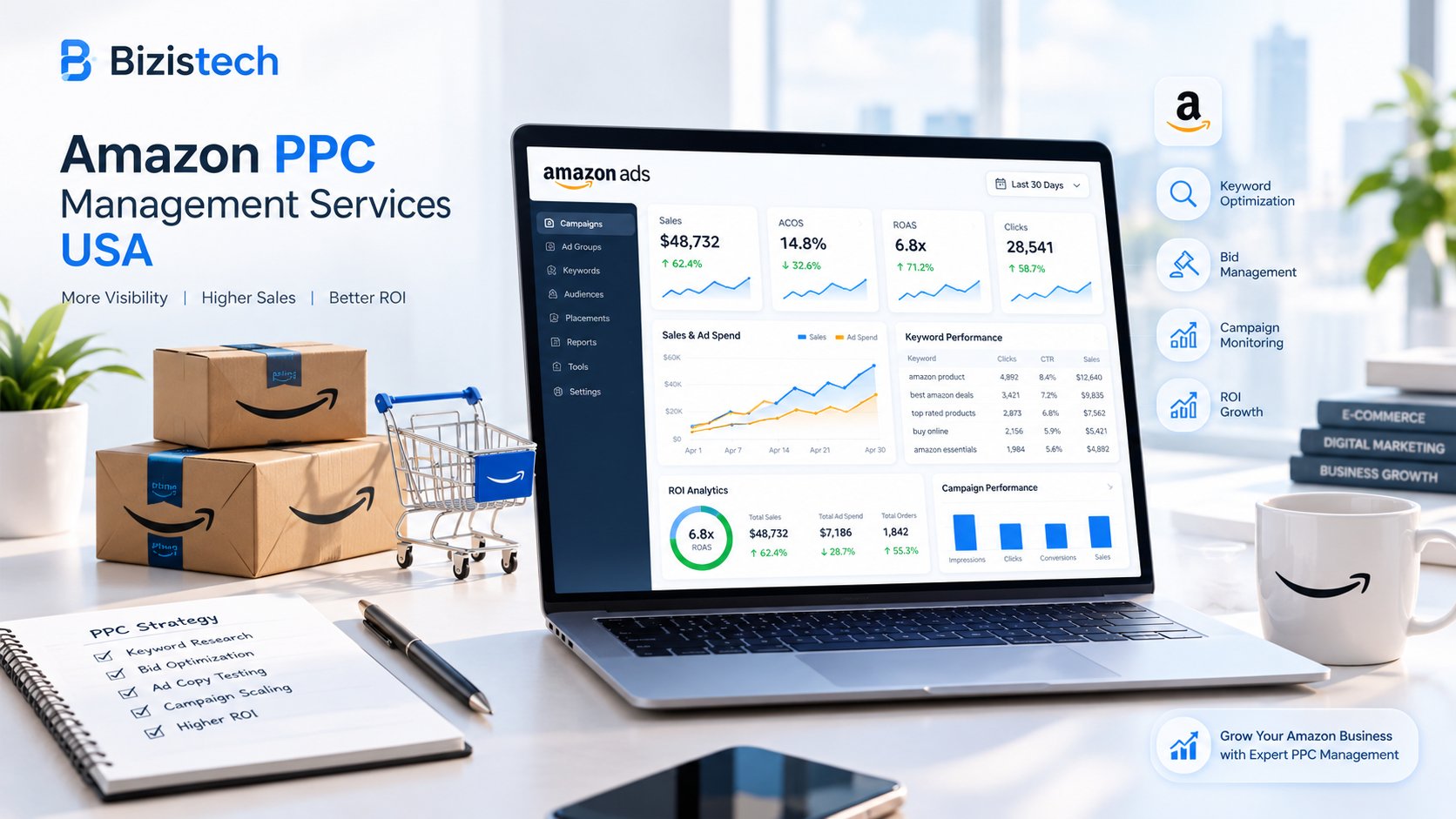
Seasonality adds another layer of difficulty specific to the US market. CPCs typically climb sharply around Prime Day and the Q4 holiday period as competitors raise bids to capture holiday traffic, then settle back down in the following weeks. A campaign left on static bids through that cycle either overpays during peak competition or under-bids and loses visibility right when demand is highest — both outcomes cost money, just in different directions.
Common PPC Challenges Sellers Face
- Rising ACOS with no clear diagnosis of which campaigns or keywords are responsible
- Wasted spend on broad or automatic campaigns that trigger irrelevant search terms
- Underused Sponsored Brands and Sponsored Display, which many sellers set up once and never revisit
- No consistent link between advertising data and actual profit margins
- Limited time to review search term reports weekly, which is where most optimization opportunity lives
What Amazon PPC Management Services Typically Include
Campaign Structure & Setup
A properly structured account separates automatic and manual campaigns, isolates branded and non-branded keywords, and organizes campaigns by match type so performance data stays clean and actionable. Most management services start with a structural audit or rebuild before any optimization begins, since a poorly structured account makes accurate bid decisions nearly impossible.
This matters more than it sounds. If broad-match and exact-match keywords sit in the same ad group, for example, it becomes impossible to tell whether a strong conversion rate is coming from precise, high-intent searches or from the broader match type accidentally catching relevant traffic. Untangling that later — after months of blended data — takes far longer than structuring it correctly from the start.
Keyword Research & Bid Optimization
This includes identifying relevant search terms through Amazon’s own data (search term reports, the Brand Analytics dashboard for Brand Registry sellers) and external keyword tools, then adjusting bids based on conversion rate, ACOS targets, and placement performance. Ongoing bid management — not a one-time setup — is what most separates a managed account from a self-managed one.
Placement data specifically tends to get overlooked. Amazon reports performance separately for top-of-search, rest-of-search, and product-page placements, and these often perform very differently for the same keyword. A term that converts well at the top of search can lose money on product pages, and adjusting a single blended bid for both ignores that difference entirely. Granular placement-level bid adjustments are one of the more technical parts of ongoing management, and one of the easiest to skip if a provider is managing on autopilot.
Sponsored Products, Brands, and Display — and DSP
Full-service management typically covers Sponsored Products (the core ad type most sellers start with), Sponsored Brands (headline and video placements that build brand visibility), and Sponsored Display (retargeting and audience-based ads). Larger accounts with sufficient spend may also incorporate Amazon DSP for programmatic advertising across and beyond Amazon’s own properties.
Each format plays a different role, and treating them as interchangeable is a common source of wasted spend. Sponsored Products drives direct, bottom-of-funnel sales and is where most budgets should start. Sponsored Brands works best once a catalog has at least a few related products to showcase together, since it’s built around a storefront-style ad format rather than a single listing. Sponsored Display’s retargeting function is most useful for brands with enough traffic volume to build a meaningful audience to re-target — it tends to underperform on very low-traffic accounts simply because there isn’t enough audience data to work with yet.
Reporting & Performance Analysis
Regular reporting — usually weekly or biweekly, with a monthly summary — should tie ad performance back to business metrics rather than vanity numbers. Useful reports track ACOS and TACOS trends, spend-to-sales ratios by campaign, and month-over-month changes, with clear explanations of what changed and why, not just raw dashboard exports.
How to Choose an Amazon PPC Management Service in the USA
In-House vs Agency vs Freelancer
In-house management gives the most control and the deepest product knowledge, but requires either a dedicated hire or significant owner time — and PPC specialists with genuine Amazon experience are not cheap to hire directly. Freelancers are typically the lowest-cost option and can work well for small, single-category accounts, though availability and consistency vary widely, and a single point of failure (illness, a change in availability, a shift in priorities) can leave an account unmanaged for weeks with no backup.
Agencies sit in between: higher cost than a freelancer, but with more structured processes, backup coverage if a specialist leaves, and usually broader experience across categories and ad types. For sellers scaling past a few thousand dollars a month in spend, an agency’s process consistency tends to outweigh the cost difference — particularly because a documented process means the account doesn’t reset to zero if a specific team member changes roles.
Pricing Models Explained
Most Amazon PPC management services in the USA use one of three pricing structures. A flat monthly fee gives predictable cost regardless of ad spend, and works well for sellers who want cost certainty and have a relatively stable budget. A percentage-of-ad-spend model (commonly 10–20%) scales with the account, which aligns incentives at higher spend levels but can become expensive as budgets grow — a $20,000/month spend at 15% is a $3,000 management fee, which may exceed what a flat-fee alternative would cost at the same account size. A hybrid model — a lower base fee plus a smaller percentage — is increasingly common because it balances predictability with scalability.
There is no universally “correct” model; the right one depends on how large and how variable your monthly ad budget is. Sellers with seasonal spend spikes (holiday-heavy categories, for instance) often find flat fees more predictable for cash-flow planning, while sellers with steadily growing budgets may prefer a percentage model that scales naturally with the account rather than requiring a fee renegotiation every time spend increases.
Questions to Ask Before Hiring
- What is your reporting cadence, and can I see a sample report?
- Do you set ACOS/TACOS targets collaboratively, or apply a fixed formula regardless of category?
- Who will actually manage my account — a named specialist or a rotating team?
- How do you handle new product launches versus mature, established ASINs?
- What’s included in the fee, and what counts as a billable extra (e.g., DSP, creative, A+ content)?
- Can you share anonymized before/after performance data from a comparable account?
Amazon PPC Management Pricing in the USA
Pricing varies by provider size, service scope, and account complexity. The table below reflects typical ranges seen across the US market as of 2026 — actual quotes should always be confirmed directly with a provider based on your specific catalog and ad spend.
| Pricing Model | Typical Range | Best Fit |
| Flat monthly fee | $500 – $3,000+/month | Sellers wanting predictable costs; small-to-mid catalogs |
| Percentage of ad spend | 10% – 20% of spend | Sellers with fluctuating or growing budgets |
| Hybrid (base + %) | $300–$1,000 base + 5–10% | Mid-size to larger accounts wanting balance |
| Freelancer / independent | $300 – $1,500/month | Small, single-category accounts on tighter budgets |
Amazon PPC Management Timeline: What to Expect Month by Month
Understanding the typical arc of a managed account helps set realistic expectations before signing on with a provider.
In the first 30 days, most of the work is structural: auditing or rebuilding campaign organization, mining historical search term data for immediate negative keyword opportunities, and setting an initial ACOS target based on product margin. ACOS often looks worse before it improves during this phase, since inefficient spend is still being identified rather than eliminated.
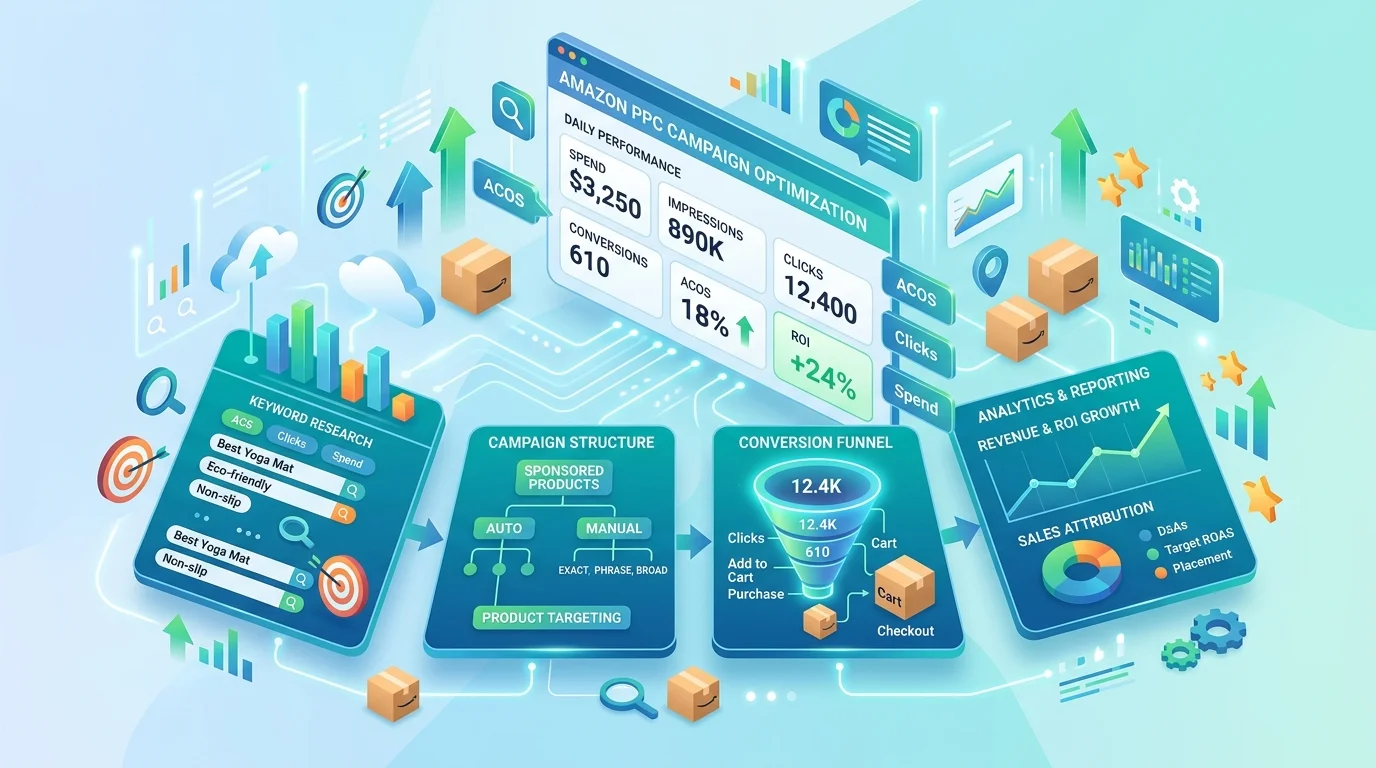
Between days 30 and 60, bid adjustments and negative keyword additions typically accelerate as enough fresh data accumulates to make confident decisions. This is usually when the first meaningful ACOS improvement becomes visible, though it can vary significantly by category and starting point.
From day 60 onward, management shifts from cleanup toward growth — expanding into new keyword territory, testing Sponsored Brands creative variations, and reallocating budget toward the best-performing campaigns. A provider still doing foundational cleanup work at the 90-day mark, with no growth-oriented experiments underway, is often a sign the account was under-resourced from the start.
Red Flags to Watch For When Evaluating a Provider
Beyond the vetting questions above, a few patterns are worth watching for once an engagement is already underway.
- Reports that show the same summary language month after month with no explanation of what specifically changed
- Reluctance to share account-level access or login credentials, which limits your ability to verify what’s actually being done
- A fixed ACOS target applied across every product regardless of margin, category, or competitiveness
- No mention of negative keywords in reporting, which usually means search term reports aren’t being reviewed
- Long response times to basic questions about strategy or specific campaign decisions
- Contracts with long lock-in periods and no clear off-ramp if performance doesn’t improve within a reasonable window
Practical Examples: What Good PPC Management Looks Like
A useful way to evaluate whether PPC management is being done well is to look at the pattern of adjustments over time rather than a single snapshot. A well-managed account typically shows a steady narrowing of search terms toward high-converting queries, a declining share of spend on irrelevant automatic-campaign clicks, and Sponsored Brands campaigns that get revisited and refreshed rather than left untouched for months. Negative keyword lists grow consistently week over week in the early months of an account, then stabilize as wasted spend is filtered out.
By contrast, an account that shows flat, unchanging bids and the same five keywords in every weekly report over several months is usually a sign that “management” has become passive monitoring rather than active optimization. Another useful check: ask to see how budget allocation across products has shifted over the past quarter. A managed account should show budget migrating toward what’s actually converting, not remaining static across every ASIN regardless of performance.
Common Mistakes Sellers Make With Amazon PPC
Most PPC underperformance traces back to a small set of recurring mistakes rather than anything unique to a given category or product. Recognizing these patterns is often more useful than any single optimization tactic.
- Chasing a low ACOS number in isolation, without factoring in TACOS or overall profit margin
- Leaving automatic campaigns running indefinitely without mining search term reports for negative keywords
- Setting bids once at launch and never revisiting them as competition and CPCs shift
- Treating Sponsored Brands and Sponsored Display as optional add-ons rather than part of a full-funnel strategy
- Judging a new campaign’s performance after only a few days, before Amazon’s algorithm has enough data to optimize delivery
- Hiring based on price alone without checking reporting quality or account access transparency
Expert Tips for Maximizing ROI
These are practical, implementation-level habits that tend to separate accounts with steadily improving efficiency from ones that plateau after the initial setup phase.
- Separate campaigns by match type (broad, phrase, exact) so bid and budget decisions can be made independently for each
- Review search term reports at least weekly during the first 60–90 days of a new campaign, when the most wasted spend typically surfaces
- Set ACOS targets relative to your product’s actual margin, not an arbitrary industry benchmark
- Use Sponsored Brands to defend branded search terms once competitors start bidding on your brand name
- Reassess budget allocation across ASINs monthly — a top performer left under-budgeted is a common missed opportunity
- Track TACOS alongside ACOS to see the full picture of organic-plus-paid sales, not just ad-attributed sales
When You Might NOT Need a PPC Management Service
Professional management isn’t automatically the right move for every seller. If your catalog is very small (one to three SKUs), your monthly ad spend is under a few hundred dollars, or you have the time and willingness to learn Amazon Advertising’s console in depth, self-management can be perfectly viable — and the cost of a service may not be justified relative to the account’s size. It’s also worth managing in-house temporarily while validating a new product, since early-stage campaigns benefit from close, day-to-day founder attention before a repeatable process is worth handing off.
The point at which outsourcing typically starts to pay for itself is when either the catalog or the ad spend grows large enough that weekly optimization becomes more time than an owner or small team can reasonably sustain. A rough rule of thumb some sellers use: once weekly PPC tasks (bid review, search term mining, negative keyword additions, reporting) start consistently taking more than three or four hours a week, the opportunity cost of that time — versus other parts of the business — usually starts to exceed what a management service would charge.
There’s also a middle path worth considering before committing to full outsourcing: a one-time PPC audit. Rather than handing over ongoing management, a paid or free audit can flag structural issues and immediate optimization opportunities, which a seller can then implement themselves. This works well for sellers who aren’t ready to commit to a monthly retainer but want a clear-eyed assessment of whether their current approach is leaving money on the table.
Frequently Asked Questions
How much does Amazon PPC management cost in the USA?
Most providers charge either a flat monthly fee ($500–$3,000+), a percentage of ad spend (10–20%), or a hybrid of both. Freelancers tend to sit at the lower end; full-service agencies at the higher end, reflecting broader reporting, strategy support, and backup coverage. The right comparison isn’t just the fee itself but what’s included at that price point — a $500 flat fee with minimal reporting may cost more in wasted spend than a $1,200 fee with active weekly optimization.
Is Amazon PPC management worth it for small sellers?
It depends on catalog size and ad spend. Sellers with very small budgets or only a few SKUs often manage adequately in-house, since the time investment is manageable and the account is simple enough to track manually. Once spend or catalog size grows, the time required to optimize properly usually outweighs the cost of outsourcing, particularly once weekly search term review alone starts taking several hours.
What’s the difference between ACOS and TACOS?
ACOS measures ad spend as a percentage of ad-attributed sales only. TACOS measures ad spend against total sales, including organic. TACOS gives a fuller picture of how advertising is affecting overall business performance, not just ad performance in isolation — a campaign can show a rising ACOS while TACOS stays flat or improves, if the ads are pulling in organic sales momentum alongside direct ad conversions.
Do I need Brand Registry to use PPC management services?
Not for Sponsored Products, but Sponsored Brands, Sponsored Display, and access to Brand Analytics data require Brand Registry. Most full-service management engagements assume Brand Registry is in place or help sellers get registered first, since Brand Analytics data materially improves keyword research quality.
How long does it take to see results from Amazon PPC management?
Meaningful trends usually take 60–90 days to emerge, since Amazon’s algorithm needs sufficient data to optimize delivery and a management team needs several optimization cycles to refine keywords and bids. Be cautious of providers promising dramatic results within the first two weeks — early wins are usually just early cleanup, not a settled performance trend.
Can I manage some campaigns in-house and outsource others?
Yes. A common approach is keeping branded or highly product-specific campaigns in-house, where founder knowledge adds the most value, while outsourcing broader discovery and Sponsored Display/DSP campaigns that require more ongoing optimization time and platform-specific expertise.
What reports should I expect from a PPC management service?
At minimum, a weekly or biweekly summary of spend, ACOS/TACOS trends, and key campaign changes, plus a monthly report tying performance to overall account goals. Ask for a sample report before signing any agreement, and check whether it explains the reasoning behind changes or just lists numbers.
Does Amazon PPC management include Amazon DSP?
Not always — DSP is often a separate service or add-on due to its higher spend minimums and different targeting approach (programmatic, audience-based, and off-Amazon inventory). Confirm scope explicitly before assuming it’s included, since DSP typically requires a distinct strategy and reporting structure from Sponsored Products management.
How do I know if my current PPC management is actually working?
Look for active, ongoing adjustments — growing negative keyword lists, refined targeting, and bid changes tied to explained reasoning — rather than static reports showing the same campaigns and keywords month after month. A quick way to check: compare this month’s top search terms to three months ago and see if anything has actually changed.
Should I choose an agency based in the USA specifically?
Location matters less than familiarity with the US marketplace’s competitive dynamics, category trends, and Amazon’s US-specific advertising features. Many effective providers work remotely with US-based sellers; what matters more is demonstrated US marketplace experience, clear communication, and transparent reporting.
What happens to my account data if I switch PPC management providers?
Your campaign history, search term data, and performance data live inside your own Amazon Advertising account, not with the provider — so switching doesn’t mean starting over from scratch. A new provider should be able to review historical performance and build on existing data rather than rebuilding campaigns from zero.
Final Takeaway
Amazon PPC management services exist to handle the continuous, data-heavy work of keeping ad campaigns profitable — something that becomes harder to sustain in-house as a catalog or ad budget grows. Whether the right move is staying in-house, hiring a freelancer, or working with a full-service agency like Bizistech depends on your current spend, catalog size, and how much time you can realistically dedicate to weekly optimization. Whatever path you choose, prioritize transparent reporting, a clear structure for campaigns and keywords, and a provider willing to explain the reasoning behind their decisions — not just the results. A provider who can walk you through why a specific bid changed, or why a keyword was cut, is far more valuable long-term than one who simply reports a favorable ACOS number without context. That transparency is usually the clearest signal of whether an account is being actively optimized or just monitored.
