
Introduction
If your Amazon listings are getting impressions but not sales, or you’ve tried tweaking titles and bullet points yourself with no real movement, you’re probably weighing whether to bring in an amazon product listing optimization agency. This guide is written for sellers and brand owners — from single-SKU startups to established brands managing dozens of ASINs — who need a clear, practical way to evaluate whether outside help is worth it, and how to tell a genuinely capable agency from one that will just rewrite your bullet points and call it a day. You’ll come away with a concrete evaluation framework, a realistic sense of cost, an inside look at how a proper engagement runs from audit to iteration, and the questions to ask before you sign anything.
Amazon listing optimization sits at an odd intersection: part copywriting, part search engine optimization, part conversion design, and increasingly, part preparing your content for AI-driven shopping tools like Rufus that summarize and compare products for customers before they ever click through. That combination is exactly why so many agencies fall short — most are strong in one of those disciplines and weak in the other two. Knowing which discipline your listings are actually weak in is the first step to hiring the right partner, or to knowing you don’t need one yet.
Quick Answer
A good amazon product listing optimization agency does more than swap in keywords: it researches how customers actually search, rewrites titles and bullet points around conversion (not just discoverability), builds A+ Content and imagery that answer buying objections, and ties the work to measurable changes in click-through rate, conversion rate, and ranking. Expect to pay anywhere from a few hundred dollars for a single-listing audit to $1,500–5,000+ per month for ongoing, multi-SKU optimization, usually bundled with advertising management.
What Does an Amazon Product Listing Optimization Agency Actually Do?
“Listing optimization” gets used loosely, so it helps to break it into the actual deliverables a competent agency provides:
- Keyword research — identifying the terms customers use, including backend search terms Amazon doesn’t display publicly
- Title, bullet point, and product description rewrites built around both discoverability and persuasion
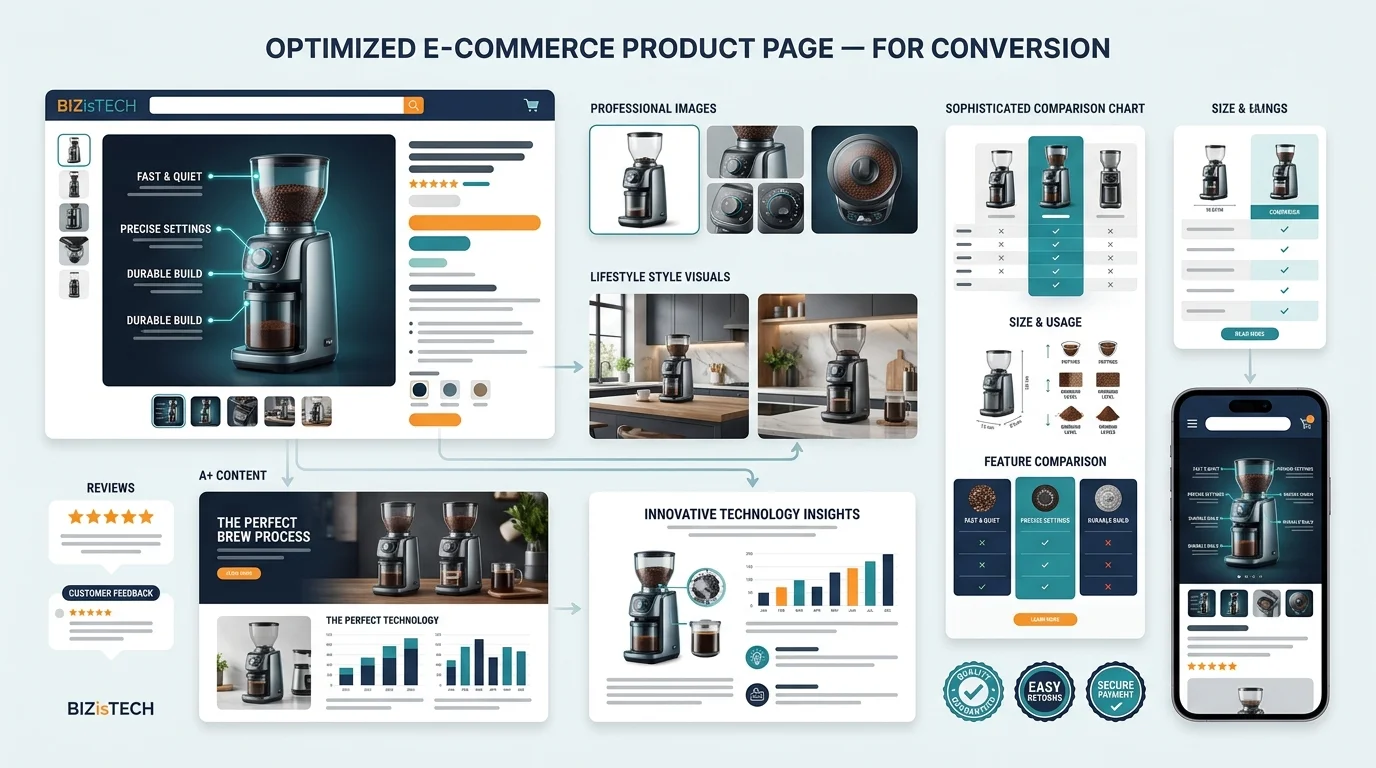
- A+ Content (Enhanced Brand Content) design — modular, image-and-text layouts that appear below the fold for Brand Registered sellers
- Image strategy — lifestyle shots, infographics, comparison charts, and sizing/usage graphics that reduce buyer hesitation
- Backend search term optimization inside Seller Central, which affects indexing but isn’t visible to shoppers
- Competitor and category analysis to identify gaps the listing isn’t currently covering
- Ongoing monitoring — tracking ranking, conversion rate, and Buy Box health, and adjusting copy or images when performance drifts
The common thread is that none of this is purely cosmetic. Amazon’s ranking system (commonly referred to as A9, with newer AI-driven shopping features like Rufus increasingly influencing what gets surfaced) weighs relevance signals from your listing text alongside sales velocity and conversion rate. A listing that ranks well but doesn’t convert will eventually rank worse, because Amazon deprioritizes listings that don’t sell. That’s why real optimization work has to address both discoverability and persuasion at the same time — an agency that only touches keywords, or only touches design, is doing half the job.
How Amazon’s Search and Ranking System Actually Uses Your Listing
It helps to understand, at a practical level, what Amazon’s system is doing with your listing content, because it explains why certain optimization tactics work and others are wasted effort. When a shopper searches a term, Amazon first builds a pool of listings it considers relevant to that query — this is largely a text-matching step, pulling from your title, bullet points, description, and backend search terms. Within that relevant pool, Amazon then ranks listings primarily by performance signals: historical click-through rate, conversion rate, sales velocity, price competitiveness, and inventory/fulfillment reliability.
That two-step process is why keyword stuffing alone doesn’t work long-term. Cramming a term into your title might get you into the relevant pool for that query, but if the listing then underperforms on click-through or conversion for that traffic, Amazon’s system learns not to show it for that term as often. Conversely, a listing with slightly less keyword coverage but strong conversion will often outrank a keyword-heavy competitor over time. Good optimization treats relevance and performance as one connected system rather than two separate projects.
Rufus and similar AI shopping features add a newer layer: they read and summarize listing content to answer shopper questions directly, sometimes before the shopper ever reaches your product page. Listings with clear, specific, well-organized information — rather than vague marketing language — are easier for these systems to summarize accurately, which is quickly becoming its own optimization consideration alongside traditional keyword relevance.
Signs Your Amazon Listings Need Professional Optimization
Not every listing needs an agency. These are the patterns that usually justify bringing in outside help rather than tweaking things yourself:
- Impressions are healthy but click-through rate is low — usually a title, main image, or price-perception problem
- Clicks are decent but conversion rate is weak — usually a bullet point, A+ Content, or review/trust problem
- Ranking has been flat or declining for keywords you used to rank well for
- You’re running PPC but paying more per click than the category average because organic relevance is weak
- A recent Amazon policy or algorithm shift has changed what “optimized” even means, and you don’t have time to keep up
- You have Brand Registry but no A+ Content, or A+ Content that hasn’t been touched since launch

What to Look for in a Listing Optimization Agency — An Evaluation Framework
Most agency pitches sound similar. The differences show up in specifics. Use these six criteria when comparing options.
Keyword Research Methodology
Ask exactly which tools and process they use, and whether they research backend search terms separately from front-end copy. A good agency can explain how they prioritize keywords by a mix of search volume, relevance, and competition — not just “the top 10 highest-volume terms.” They should also be able to explain how they handle keyword variants: plurals, common misspellings, regional spelling differences (US vs UK), and “for [use case]” phrasing, since these often carry meaningful search volume that a surface-level keyword pull misses entirely. Be wary of anyone who won’t explain their methodology at all; that usually means there isn’t one, and you’re paying for a template.
Copywriting and Conversion Expertise
Ask to see writing samples for your category, or at least a similar one. Amazon copy that’s technically keyword-rich but reads like a keyword list will hurt conversion even if it helps ranking short-term. Strong copy answers the customer’s real questions — what problem does this solve, how is it different from the ten similar listings next to it, what could go wrong if I buy the wrong one — in the first few bullet points, since most shoppers don’t read past that. A useful test when reviewing a writer’s sample: could you remove the brand name and still tell what makes this product different from its closest competitor? If the copy is interchangeable with any other listing in the category, it isn’t doing its job.
A+ Content and Brand Story Capability
A+ Content is one of the highest-leverage things a Brand Registered seller can invest in, because it directly addresses objections images and bullet points can’t — sizing confusion, material questions, “what’s in the box,” and side-by-side comparisons against your own product line. Ask whether the agency designs custom modules or reuses templates, and whether they test different layouts against performance rather than shipping one version and moving on. Also ask how they sequence modules: the strongest A+ layouts front-load the objection most likely to stop a purchase, rather than starting with a generic brand story that most shoppers scroll past.
Image and Creative Strategy
Images typically drive more of the click-through and conversion decision than any other single element on the page. A capable agency will talk about the full image sequence — hero shot, lifestyle context, size/scale reference, comparison or “what’s included” graphics — not just “we’ll make it look nicer.” Ask whether they design specifically for mobile thumbnails, since most Amazon browsing now happens on small screens where a busy or text-heavy main image becomes illegible and actively hurts click-through rate.
Reporting and Transparency
Ask what gets reported, how often, and whether you’ll see raw Seller Central data or only the agency’s own summary. Reasonable expectations: ranking movement for target keywords, click-through rate, conversion rate, and Buy Box/inventory health, reviewed at least monthly, with a clear before/after comparison tied back to the specific changes made. If an agency can’t describe what they’ll show you before you sign, that’s worth pressing on — vague reporting is one of the easiest ways for underperforming work to go unnoticed for months.
Pricing Models
Agencies typically price by one-time project (a single listing rewrite or audit), monthly retainer (ongoing optimization across a catalog), or a hybrid with a project fee plus a smaller ongoing management fee. Retainers make more sense once you have several SKUs or a catalog that changes seasonally, since keyword relevance and competitor positioning shift over time and a one-time rewrite goes stale. A one-time project is often enough for a single hero product that doesn’t change often. Watch for agencies that only offer long-term retainers with no project-based entry point — it can signal that the ongoing fee is doing more to retain the client than to keep improving the listing.
DIY vs. Hiring an Agency — When Each Makes Sense
DIY optimization can work well if you have one or two listings, time to learn Amazon’s specific formatting and character-limit rules, and the patience to test changes slowly. Free and low-cost keyword tools, Amazon’s own Seller Central resources, and competitor listing research can get a motivated seller most of the way there for a simple product.
An agency tends to pay for itself once any of the following is true: you’re managing more than a handful of SKUs, you’re also running amazon PPC advertising services alongside organic optimization (since the two should be coordinated, not managed separately), you don’t have in-house design capability for A+ Content, or the cost of your own time working on listings exceeds what an agency would charge. For sellers already juggling amazon seller central management day to day, listing work is often the first thing that gets neglected — which is usually when it makes sense to hand it off.
A middle path worth considering: hire an agency for a one-time audit and rewrite of your top-performing listings, then maintain the work in-house using the framework they establish, and only move to a full retainer once the catalog grows past what you can reasonably keep up with yourself. This limits upfront cost while still giving you a professional baseline to work from.
What a Good Listing Optimization Engagement Looks Like, Step by Step
- Audit: the agency reviews current listings against category competitors, backend search terms, and current performance data (CTR, conversion rate, ranking) to establish a baseline, and identifies which specific element — title, images, bullets, or A+ Content — is most likely responsible for underperformance.
- Keyword mapping: relevant terms are prioritized and mapped to specific listing elements — title, bullets, backend fields, A+ Content — rather than crammed wherever they fit, with the highest-priority terms placed earliest in the title and first bullet point where they carry the most weight.
- Copywriting: titles, bullet points, and descriptions are rewritten around both relevance and persuasion, following Amazon’s character and formatting rules, and typically go through at least one internal review pass before the client sees a draft.
- Creative: images and A+ Content are designed or redesigned to address specific buying objections identified in the audit, sequenced so the most decision-critical information appears in the first three to four images.
- Client review: drafts are shared for approval, ideally with the reasoning behind key changes explained rather than just delivered as a finished file — this is where you can catch anything that misrepresents the product.
- Implementation: changes are uploaded through Seller Central or Vendor Central, respecting Amazon’s content policies to avoid suppression, and timed to avoid major sale events where a mid-event change could disrupt a listing that’s already performing.
- Monitoring: performance is tracked for several weeks post-launch, since Amazon’s system needs time to re-index and re-rank a changed listing before the new version’s true performance is visible.
- Iteration: underperforming elements are revised based on what the data shows, rather than treating the first version as final — this is the step most DIY efforts and low-effort agencies skip entirely.
Practical Examples
A typical scenario: a seller with strong impressions but a conversion rate well below their subcategory average usually has a mismatch between what the main image promises and what the bullet points deliver — for example, an image implying premium materials with copy that never mentions them. The fix is rarely a full rewrite; it’s usually re-sequencing the first two bullet points and swapping in a comparison-style secondary image.
Another common pattern: a listing that ranks well for its primary keyword but is invisible for close variants (plural forms, common misspellings, “for [use case]” phrasing) because those terms were never added to the backend search terms field. That’s a low-effort, high-impact fix an experienced agency catches in the first audit pass.
A less common but costly mistake: sellers who redesign A+ Content right before a seasonal peak without leaving buffer time for Amazon’s re-indexing and any review/approval delay, and end up entering the peak with an inconsistent or partially-updated page. Good agencies build in a testing and buffer window before high-traffic periods rather than optimizing reactively.
Common Mistakes Brands Make
Some of these mistakes happen when brands manage listings in-house; others happen even after hiring an agency, because the client side of the relationship matters too.
- Hiring based on price alone, without checking whether the agency has worked in a similar category — copy and imagery that work for a commodity kitchen product won’t automatically translate to a technical or regulated category
- Treating optimization as a one-time project instead of an ongoing process — competitors’ listings change, seasonal search behavior shifts, and Amazon’s algorithm updates regularly, so a listing that was optimal six months ago may no longer be
- Optimizing copy and images without coordinating with PPC, so ad spend is driving traffic to a page that isn’t converting well — wasted spend that a coordinated strategy would have caught immediately
- Overloading titles and bullets with keywords at the expense of readability, which usually lowers conversion even if it briefly helps ranking, and often gets suppressed outright under Amazon’s title-length or formatting rules
- Not defining what “success” looks like before the engagement starts, which makes it impossible to tell later whether the work actually helped — agree on which metrics you’ll track and what a meaningful change looks like before any work begins
- Changing listings too frequently based on short-term data — a week or two of results after a change usually isn’t enough signal, especially for lower-traffic ASINs, and reacting too fast can mask whether a change was actually working
Red Flags to Watch For
- Guarantees of a specific ranking position or sales number — no legitimate agency controls Amazon’s algorithm closely enough to promise this, and a guarantee is often a sign of an unsustainable sales pitch rather than real expertise
- Refusal to explain their process or show any sample work, even redacted to protect a current client’s identity
- Pricing that seems far below the market range for the scope described — often a sign of templated, non-custom work reused across many unrelated clients
- No mention of backend search terms, A+ Content, or image strategy — a sign the “optimization” is limited to front-end copy only and misses most of the actual leverage available
- Long-term contracts with no early exit option and no defined reporting cadence, which makes it hard to leave if the work isn’t performing
- Heavy focus on the sales pitch and light on specifics when you ask direct process questions — a capable team is usually more comfortable getting into the weeds than a purely sales-driven one
What Listing Optimization Typically Costs
Pricing varies by scope, category complexity, and whether the work is bundled with advertising management, but reported industry ranges generally fall into these bands:
- Single-listing audit or rewrite: roughly $300–$1,500 as a one-time project
- A+ Content design (per listing or module set): roughly $200–$800
- Ongoing multi-SKU optimization retainer: roughly $1,000–$3,000+ per month depending on catalog size
- Bundled optimization + amazon advertising management services: often $1,500–5,000+ per month once PPC management is included
These are general market ranges, not a quote — actual pricing depends heavily on catalog size, category, and how much creative work (photography, A+ design) is included versus copywriting alone. Categories that require technical accuracy — supplements, electronics, anything with regulatory claims — tend to sit at the higher end of these ranges, since the copywriting requires more research and often a compliance review pass. A brand with 5 SKUs and simple, non-technical products will generally pay toward the lower end of the retainer range; a brand with 50+ SKUs across multiple subcategories, or one entering Vendor Central’s more restrictive content rules, should expect to pay toward the higher end or negotiate a scope that prioritizes the top-performing ASINs first rather than the full catalog at once.
Final Takeaway
The right amazon product listing optimization agency treats your listings as a system — keywords, copy, images, and A+ Content working together, coordinated with advertising rather than sitting in a separate silo — and can explain their methodology in specifics rather than vague promises. Whether you handle it yourself or bring in help, start from an honest audit of where clicks and conversions are actually leaking, since that’s what determines whether a rewrite, a redesign, or a full re-strategy is what you actually need.

Frequently Asked Questions
What does an amazon product listing optimization agency actually do?
It researches how customers search for your product, rewrites titles, bullet points, and descriptions for both discoverability and conversion, builds A+ Content and supporting imagery, optimizes backend search terms, and monitors performance to adjust the listing over time.
How much does amazon listing optimization cost?
A single-listing audit or rewrite typically runs $300–1,500 as a one-time project. Ongoing multi-SKU retainers generally run $1,000–3,000+ per month, and often $1,500–5,000+ when bundled with PPC management.
Is it worth hiring an agency instead of doing it myself?
For one or two listings with time to learn Amazon’s formatting rules, DIY can work. An agency tends to pay for itself once you’re managing multiple SKUs, running paid ads alongside organic listings, or lack in-house design capability for A+ Content.
How long does it take to see results after optimizing a listing?
Amazon typically needs one to several weeks to re-index a changed listing and reflect new ranking positions, and conversion-rate changes usually need a similar window of consistent traffic to read reliably.
What’s the difference between listing optimization and Amazon PPC?
Listing optimization improves the page itself — relevance, ranking, and conversion. PPC drives paid traffic to that page. The two work best together: PPC without a converting listing wastes ad spend, and a great listing with no traffic won’t sell.
Do I need Brand Registry to optimize my listings?
No — title, bullet point, and backend search term optimization are available to all sellers. A+ Content and Enhanced Brand Content, however, require Amazon Brand Registry.
Can optimization hurt my ranking if done incorrectly?
Yes. Overloading keywords at the expense of readability, using restricted terms, or making changes that violate Amazon’s content policies can trigger listing suppression or a temporary ranking drop.
How do I know if my current listings actually need optimization?
Compare click-through rate and conversion rate for each listing against your subcategory averages in Seller Central’s Brand Analytics. A gap in either metric, or flat/declining ranking for keywords you used to rank for, usually signals a listing problem.
What should I ask an agency before signing a contract?
Ask for their keyword research methodology, writing samples in a similar category, what specifically gets reported and how often, whether A+ Content and image strategy are included, and whether the contract has a defined exit point.
Should listing optimization and advertising be handled by the same agency?
It’s usually more effective when they are, since ad spend performs better when it’s driving traffic to a listing that’s already optimized to convert, and the two teams can coordinate rather than working from different assumptions about what’s working.
How often should Amazon listings be re-optimized?
A full review every 6–12 months is a reasonable baseline, with faster action if you notice a sustained drop in click-through rate, conversion rate, or ranking, or after a significant change in your competitive set.
Can I optimize listings on Vendor Central the same way as Seller Central?
The core principles — keyword relevance, conversion-focused copy, strong imagery — apply to both, but Vendor Central has stricter content and formatting rules and often a slower approval process, so changes typically need more lead time.
