Amazon Brand Analytics Explained
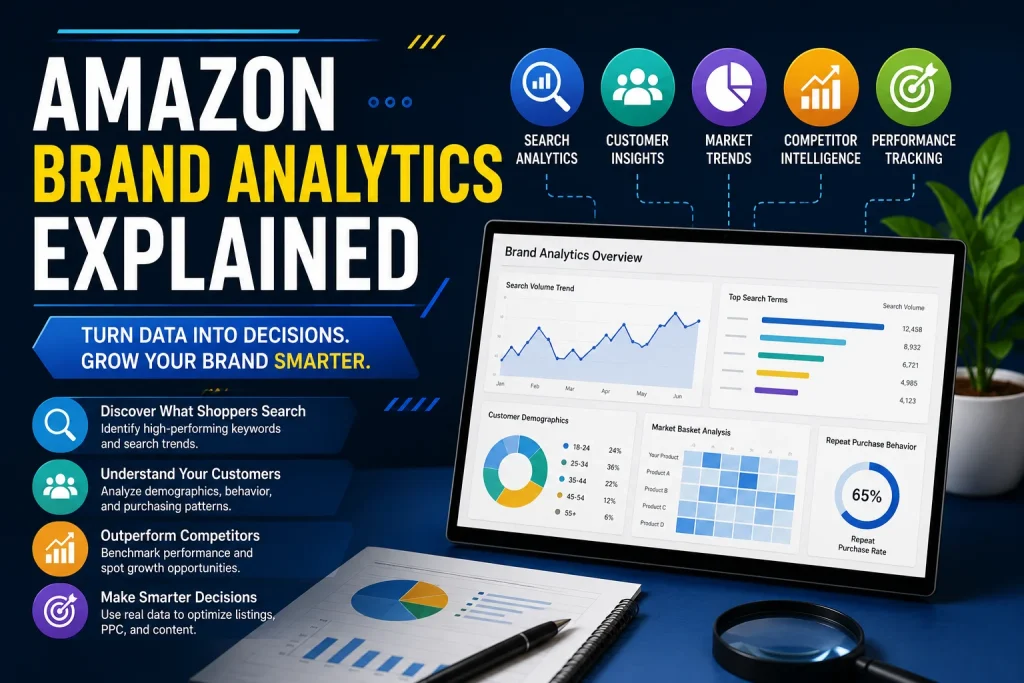
Amazon Brand Analytics gives sellers and brand owners valuable information about how shoppers discover products, interact with listings, and move toward purchasing decisions. Instead of relying only on sales numbers, sellers can use analytics to understand customer behavior and identify opportunities for improvement. For growing brands, understanding this information can make everyday decisions more strategic. From improving product visibility to refining advertising campaigns, the right data can reveal what is working and what needs attention. What Is Amazon Brand Analytics Amazon Brand Analytics is a collection of insights available to eligible brand owners that helps them understand customer activity and product performance. The information can provide a clearer picture of search behavior, purchasing patterns, customer engagement, and competitive performance. The main purpose is to turn marketplace data into useful business decisions. Rather than guessing which products deserve more attention, sellers can examine actual customer behavior and use those findings to improve their strategy. Why Amazon Brand Analytics Matters Running an online store without studying performance data can make growth unpredictable. A product may receive strong traffic but generate few sales, while another product may convert well but receive limited visibility. Analytics helps identify these differences. By studying customer behavior, sellers can understand which products attract attention, which search terms are valuable, and where customers may be leaving before completing a purchase. These insights can then support better listing optimization, product positioning, advertising decisions, and inventory planning. Data can also help brands recognize changing customer preferences before those changes become obvious through sales alone. Important Insights to Monitor Several types of information can be especially useful when evaluating brand performance. Search behavior can show what customers are looking for and which products receive attention from those searches. This can help sellers understand demand and discover opportunities for relevant products. Customer engagement can provide clues about how effectively product pages communicate value. If customers are visiting a product but not purchasing, the listing may need improvements in its content, images, pricing, or overall presentation. Purchase behavior can reveal which products are performing well after attracting shoppers. Comparing traffic with sales can help sellers distinguish between visibility problems and conversion problems. Competitive information can also help brands understand how their products perform compared with other options in the same category. Using Analytics to Improve Product Listings One of the most practical uses of analytics is improving product listings. Suppose a product receives substantial customer attention but produces fewer purchases than expected. This could indicate that the listing is not convincing shoppers after they arrive on the product page. A seller can review the title, images, product description, key features, pricing, and overall presentation. The goal is to make the listing clearer and more relevant to customer expectations. Analytics should not be viewed as a replacement for good listing content. Instead, it provides evidence that can help determine which parts of the listing deserve improvement. Using Analytics for Better Advertising Decisions Advertising becomes more effective when campaign decisions are supported by reliable data. Sellers can examine which products attract customers, which search terms generate interest, and where advertising performance may be weaker. This is where amazon ads management services can become valuable for brands that need structured campaign analysis and optimization. Data from brand performance can help guide decisions about targeting, budget allocation, keyword selection, and campaign adjustments. The goal should not simply be to spend more on advertising. The focus should be on understanding which opportunities have the potential to produce profitable growth. Finding Customer Trends Customer behavior changes over time. Seasonal demand, new competitors, changing preferences, and product trends can all influence performance. Regularly reviewing analytics allows sellers to identify these changes earlier. A product that performs strongly during one period may require a different strategy during another. For example, increasing interest in a particular product category may indicate an opportunity to strengthen inventory, improve content, or increase promotional activity. Declining interest may suggest that the brand needs to review its positioning or identify new customer needs. Connecting Analytics With Business Goals Analytics becomes more useful when it is connected to specific business goals. If the goal is to increase sales, sellers should focus on the relationship between visibility, customer engagement, conversion, and profitability. If the goal is to improve brand awareness, attention should be given to customer discovery and product engagement. If the goal is to improve advertising efficiency, sellers should examine campaign performance alongside sales and customer behavior. This approach prevents sellers from becoming overwhelmed by large amounts of information. Instead of tracking every available number, they can focus on the data that supports their most important objectives. Common Mistakes Sellers Should Avoid One common mistake is looking at individual metrics without considering the complete customer journey. A high number by itself does not always mean strong performance. Another mistake is making major decisions based on a short period of data. Trends become more meaningful when performance is monitored consistently over time. Ignoring product level differences can also create problems. Each product may attract a different type of customer and perform differently within its category. Finally, sellers should avoid making advertising decisions without considering organic performance. Advertising and organic visibility often influence each other, so both should be evaluated as part of a broader strategy. How to Build a Data Driven Strategy A strong approach begins with regular analysis. Review important performance information, identify unusual changes, and determine what may be causing those changes. Next, prioritize the biggest opportunities. A small improvement to a high traffic product may have a greater impact than a major change to a product with very little customer interest. After making improvements, continue monitoring performance. This creates a cycle of analysis, action, measurement, and refinement. Brands using amazon ads management services can also combine advertising data with broader customer and product insights to create more informed campaign strategies. The Role of Continuous Monitoring Amazon performance can change quickly, which makes continuous monitoring important. Customer demand, competition, advertising costs, and product performance can shift over