
If you are building an ecommerce business in 2026, choosing the right marketplace is one of the most strategic decisions you will make. Two platforms dominate the conversation more than any others — Amazon and Walmart Marketplace. Both offer access to millions of US shoppers. Both have growing seller communities. And both have very different rules, costs, and growth dynamics that make them the right choice for very different types of sellers.
At Bizistech, we manage brands across both platforms and the question of selling on amazon vs Walmart marketplace comparison comes up constantly with clients who are either starting out or looking to expand. This guide gives you the honest breakdown you need to make the right decision for your specific business.
Platform Size and Traffic
When it comes to raw traffic and market share, Amazon is still the clear leader. Amazon commands roughly 38 percent of all US ecommerce sales and attracts over 200 million unique visitors per month. It is the first place most US shoppers go when they are ready to buy and that intent-driven traffic is one of its most powerful advantages for sellers.
Walmart Marketplace has grown significantly in recent years and now attracts over 120 million monthly visitors. While that is still well behind Amazon, it represents a massive and underutilized opportunity for sellers who have not yet listed on the platform. Walmart’s online traffic is growing faster than Amazon’s in percentage terms making it an increasingly attractive expansion channel for established Amazon sellers.
The key difference is shopper behavior. Amazon shoppers are searching with high purchase intent and are comfortable buying from third-party sellers. Walmart shoppers tend to associate the platform more closely with Walmart’s own brand and retail reputation — which means brand trust and pricing play a slightly larger role in the purchase decision.
Fees and Cost Structure
Understanding the cost differences between the two platforms is essential for selling on Walmart vs amazon successfully.
Amazon charges a monthly Professional Selling Plan fee of $39.99 plus referral fees that typically range from 8 to 15 percent depending on your category. If you use FBA, add fulfillment fees based on product size and weight, plus storage fees for inventory sitting in fulfillment centers.
Walmart Marketplace has no monthly subscription fee for sellers. Referral fees are broadly similar to Amazon ranging from 6 to 15 percent depending on category. However, Walmart does not have its own fulfillment network in the same way Amazon does. Sellers can use Walmart Fulfillment Services Walmart’s equivalent of FBA but many sellers still ship orders themselves or use third-party logistics providers.
For sellers with tight margins, the absence of a monthly fee on Walmart can make a meaningful difference. But for sellers who rely on the logistics infrastructure that FBA provides, Amazon’s total cost package often makes more operational sense.
Competition and Discoverability
One of the most significant advantages Walmart Marketplace currently offers is lower competition. Because fewer sellers are active on the platform compared to Amazon, new listings can achieve visibility and ranking more quickly. Categories that are brutally competitive on Amazon may have significantly less competition on Walmart giving newer brands a real chance to establish themselves.
This is one of the strongest arguments for multi-channel selling. Brands that are struggling to break through on Amazon because of entrenched competition often find that the same product gains traction on Walmart much faster and that initial success can generate the revenue and cash flow needed to invest more aggressively on Amazon.
How to sell on amazon effectively requires navigating deep competition with sophisticated PPC strategies and heavily optimized listings. Selling on Walmart requires less advertising sophistication at present but that gap is closing as more sellers enter the platform and Walmart’s ad products mature.
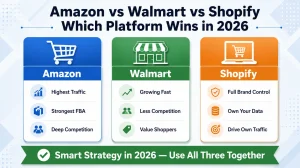
Selling on Shopify vs Amazon vs Walmart
Many sellers also ask about selling on Shopify vs amazon as a third option. The honest answer is that these are not mutually exclusive — they serve different strategic purposes.
Shopify gives you complete control over your brand experience, your customer data, and your margins. But it requires you to drive your own traffic through paid ads, SEO, and social media — which is a significant investment of time and budget that not all sellers are ready for.
Amazon and Walmart bring the traffic to you. The trade-off is less control, marketplace fees, and the risk of competition from the platform itself. For most sellers building an Amazon-first business, Shopify works best as a complementary channel for returning customers and brand building — not as a replacement for marketplace revenue.
Best Selling Items on Amazon vs Walmart
Understanding what best-selling items on amazon are versus what performs best on Walmart helps you make smarter product and channel decisions.
On Amazon, high-performing categories include electronics accessories, health and wellness products, home goods, kitchen items, and private label consumables. The platform rewards products with strong review counts, optimized listings, and competitive pricing.
On Walmart, value-oriented products perform particularly well — shoppers come to Walmart with a price-conscious mindset. Everyday essentials, household products, and recognizable brands tend to do well. Products that compete primarily on price rather than brand differentiation often find Walmart a more natural fit than Amazon.
Should You Sell on Both in 2026?
For most established sellers, the answer in 2026 is yes — but with a clear strategy for each platform rather than simply duplicating your Amazon approach on Walmart.
Bizistech helps brands develop platform-specific strategies for both Amazon and Walmart Marketplace. We understand that what works on Amazon does not always translate directly to Walmart — and we build separate optimization and advertising approaches for each platform based on its unique dynamics.
As a full-service amazon sells on Walmart marketplace 2026 management partner, we handle the complexity of multi-channel selling so you can focus on growing your brand across both platforms simultaneously.
Ready to expand to Walmart or optimize your existing Amazon presence? Get in touch with Bizistech today and let us build the right multi-channel strategy for your business.
Bizistech Amazon. Walmart. Multi-Channel Growth Done Right.
