
Rising cost-per-click rates. Declining return on ad spend. Budget that disappears before generating meaningful results. If any of these sound familiar, you are not dealing with a platform problem — you are dealing with an optimization problem. And optimization problems have solutions.
PPC optimization is the ongoing process of improving paid advertising campaign performance by reducing wasted spend, improving targeting precision, strengthening ad quality, and ensuring that the traffic your budget generates actually converts into revenue. Done consistently and correctly, it produces campaigns that deliver more value from the same or lower budget. Done sporadically or incorrectly, it produces the frustrating cycle of increasing spend without improving results.
This guide covers every major dimension of PPC optimization with the practical depth that practitioners — marketers, business owners, and agency professionals — actually need. It is built for Google Ads primarily, with specific sections addressing Amazon PPC where the mechanics differ meaningfully. At Bizistech, we manage PPC campaigns across both platforms and the principles in this guide reflect what actually moves the needle in real accounts, not just what looks good in a general article.
Quick Answer — What Is PPC Optimization and How Does It Lower CPC and Boost ROAS?
PPC optimization is the practice of systematically improving paid advertising campaigns to generate more return from every dollar spent. Lowering CPC involves improving Quality Score, tightening campaign structure, refining match types, and adding negative keywords to eliminate irrelevant clicks. Boosting ROAS requires both reducing CPC and improving conversion rate — which means better landing pages, tighter audience targeting, and stronger message alignment between ad and destination.
Understanding CPC and ROAS — The Two Numbers That Matter Most
Before optimizing anything, you need to understand precisely what these metrics measure and how they relate to each other — because most optimization mistakes come from treating them as independent variables when they are fundamentally connected.
What Is CPC and How Is It Calculated?
CPC stands for Cost Per Click. It is the amount you pay each time someone clicks on your paid advertisement. In auction-based systems like Google Ads and Amazon Advertising, your actual CPC is determined by a combination of your bid amount and your Quality Score — Google’s measurement of your ad’s relevance and expected performance.
The formula for actual CPC in Google Ads is:
Actual CPC = (Ad rank of the advertiser below you / Your Quality Score) + $0.01
This formula reveals something important that many advertisers miss: your Quality Score directly affects how much you pay per click. An advertiser with a high Quality Score can achieve the same or better ad position as a competitor with a higher bid — at a lower cost per click. This is why Quality Score improvement is one of the highest-leverage CPC reduction strategies available.
What Is ROAS and What Does a Good Number Look Like?
ROAS stands for Return on Ad Spend. It measures how much revenue you generate for every dollar spent on advertising.
ROAS = Revenue from Ads / Ad Spend × 100
A ROAS of 400% means you are generating $4 in revenue for every $1 spent on advertising. Whether that is a good number depends entirely on your profit margins. A business with 60% gross margins can sustain a much lower ROAS than a business with 20% gross margins and still remain profitable.
The practical way to calculate your minimum required ROAS is:
Minimum ROAS = 1 / Gross Margin %
For a business with 30% gross margins, the minimum breakeven ROAS is approximately 333% — meaning any ROAS below that is losing money. Understanding your specific breakeven ROAS is essential before evaluating whether your current campaigns are performing adequately.
How CPC and ROAS Are Connected
Lower CPC improves ROAS when everything else stays equal — because the same revenue from advertising now costs less to generate. But CPC reduction alone does not guarantee ROAS improvement. If lower CPC comes from targeting less qualified traffic that converts at a lower rate, ROAS can actually decline even as CPC drops.
This is the fundamental tension in PPC optimization: the goal is not to minimize CPC in isolation, but to minimize cost per conversion — which requires both competitive CPC rates and strong conversion performance from the traffic that clicks.

The 7 Core Levers for Lowering CPC
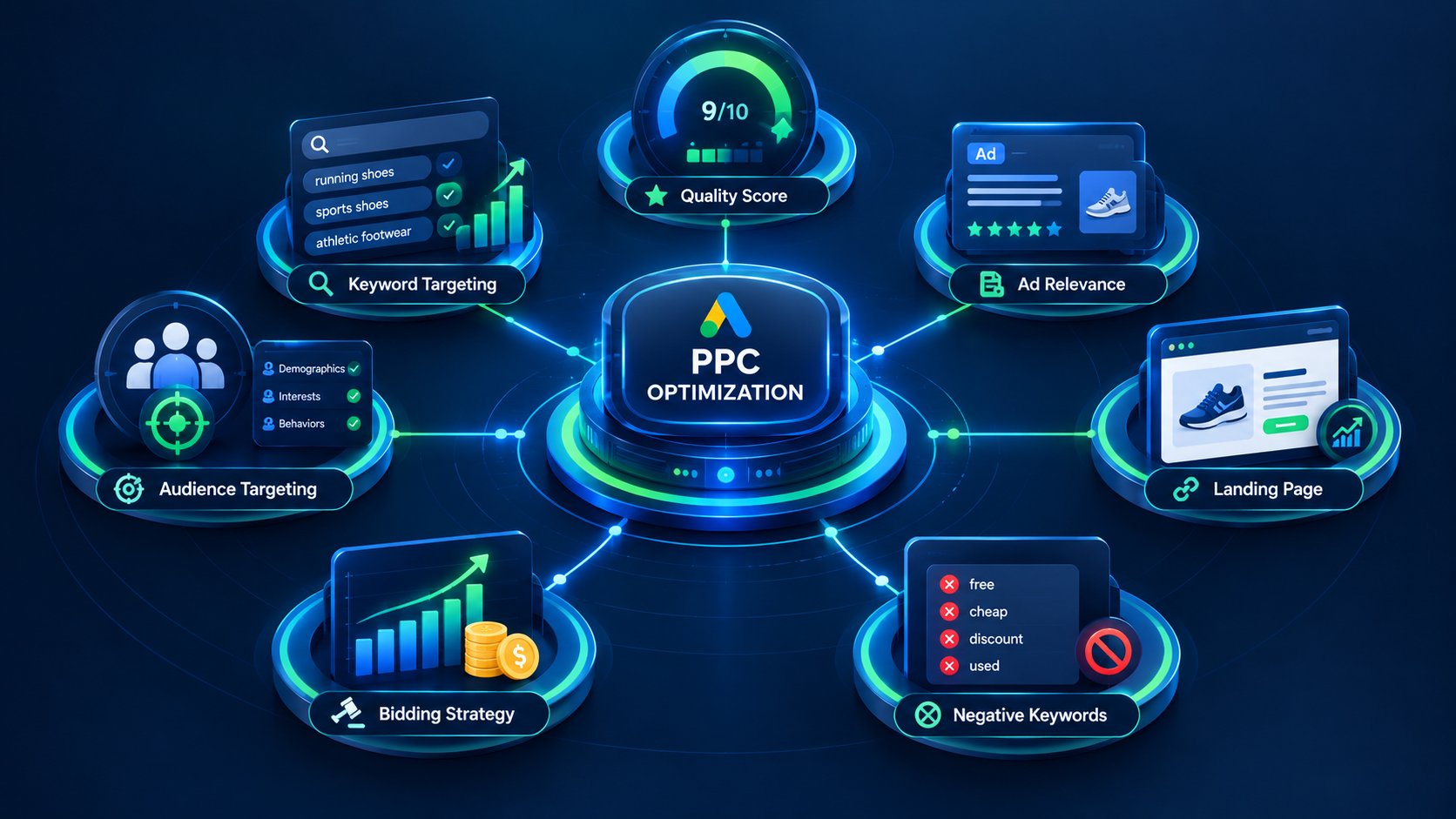
These seven optimization levers, applied consistently, produce meaningful CPC reductions across most PPC accounts. None of them are quick fixes that work once and stay fixed — all of them require ongoing attention.
- Improve Your Quality Score
Quality Score is Google’s rating of the relevance and expected performance of your keywords, ads, and landing pages on a scale of 1 to 10. Higher Quality Scores directly reduce your CPC — sometimes dramatically. An account with consistently high Quality Scores across its keywords pays significantly less per click than a competitor bidding the same amount with lower Quality Scores.
The three components of Quality Score are expected CTR, ad relevance, and landing page experience — each of which has specific, actionable improvement paths covered in the next section.
- Build Tighter Ad Groups
Over-consolidated ad groups — groups containing dozens of loosely related keywords — produce lower Quality Scores because no single ad can be genuinely relevant to every keyword in the group. Tighter ad groups with fewer, more thematically consistent keywords allow you to write ads that are specifically relevant to the keywords triggering them, which improves expected CTR and ad relevance, which improves Quality Score, which lowers CPC.
The structure progression from worse to better looks like this: campaign with one large ad group containing 50 keywords → campaign with multiple ad groups of 10–15 related keywords → tightly structured ad groups of 3–5 highly similar keywords → SKAG structure (one keyword per ad group) for maximum relevance in competitive situations.
- Use More Specific Match Types
Broad match keywords reach the widest possible audience — including many searches that have little or nothing to do with your product. While broad match has its place (particularly for keyword discovery with Smart Bidding), heavy reliance on broad match without proper negative keyword management produces clicks from irrelevant searches at your full bid rate.
Moving appropriate keywords to phrase match or exact match reduces irrelevant traffic, improves your average conversion rate, and typically lowers your effective CPC because you are paying for higher-quality traffic.
- Add Negative Keywords Consistently
Every search term that triggered your ad but did not match your product represents a wasted click — a paid visit from someone who was never going to buy from you. Negative keywords prevent these wasted clicks, improving your campaign’s efficiency immediately and providing budget that can be redirected toward searches that actually convert.
This deserves its own section below because it is simultaneously the most effective quick-win optimization available and the most consistently neglected.
- Improve Your Click-Through Rate
Higher CTR improves your expected CTR component of Quality Score, which lowers your CPC. The practical levers for CTR improvement include more compelling headlines that speak directly to search intent, stronger calls to action, effective use of ad extensions (sitelinks, callouts, structured snippets), and responsive search ad testing to identify which headline and description combinations perform best.
One counterintuitive point: a lower CTR from a more targeted, higher-intent audience often produces better overall campaign efficiency than a higher CTR from a broader, less qualified audience. CTR optimization should always be evaluated alongside conversion rate, not independently.
- Refine Your Targeting
Geographic, demographic, device, and dayparting targeting adjustments can reduce CPC by directing your budget away from times, places, and audience segments where your cost per conversion is disproportionately high.
In practice, analyzing campaign performance by dimension — geographic region, device type, day of week, hour of day — almost always reveals meaningful variance. Reducing bids or pausing entirely in segments with high CPC and low conversion rate, while increasing bids in segments with strong ROAS, is one of the most direct routes to improved overall account efficiency.
- Adjust Bids by Performance Data
Keyword-level bid management based on actual conversion data is fundamental — but many accounts either rely entirely on automated bidding without sufficient data to support it, or use manual bids set once and rarely revisited.
The practical approach is to identify your highest-converting keywords and ensure they are capturing sufficient impression share, while reducing or pausing spend on keywords consuming budget without generating conversions. This reallocation of budget from underperforming to overperforming keywords often produces significant ROAS improvement without any increase in total spend.

How to Improve Quality Score — The Most Overlooked CPC Lever
Quality Score improvement is the CPC optimization lever that most advertisers underinvest in because its effects are not immediate. But the compounding impact of consistently high Quality Scores across an account is substantial.
What Quality Score Actually Measures
Google evaluates Quality Score across three components:
Expected CTR — How likely your ad is to be clicked when shown for a given keyword, based on historical performance data for your ads and your competitors’.
Ad Relevance — How closely your ad matches the search intent behind the keyword triggering it. An ad for “men’s running shoes” triggering on a search for “basketball shoes” has poor ad relevance.
Landing Page Experience — How relevant, useful, and well-functioning your landing page is for people clicking your ad. Google evaluates content relevance, load speed, mobile usability, and the overall quality of the page experience.
Each component is rated as above average, average, or below average. Identifying which components are below average for your worst-performing keywords gives you a specific optimization roadmap rather than a vague instruction to “improve Quality Score.”
How to Improve Expected CTR
Expected CTR improves through better ad copy testing. Write multiple headline variations for each ad group — Responsive Search Ads allow up to 15 headlines — and analyze which combinations produce the strongest CTR over time. Headlines that directly address the search intent driving the keyword, include the keyword phrase naturally, and communicate a specific value proposition consistently outperform generic headlines.
Ad extensions are particularly powerful for CTR improvement because they expand your ad’s physical space on the results page and provide additional click opportunities. Sitelinks, callout extensions, and structured snippets should be used on every campaign where they are relevant.
How to Improve Ad Relevance
Ad relevance improves when your ad copy directly reflects the theme of your ad group’s keywords. If your ad group contains variations of “men’s trail running shoes,” your headline should use that language specifically — not a generic “shop our shoe collection” headline that could apply to any footwear search.
This is one of the most important reasons to maintain tight ad group structure. It is simply not possible to write a genuinely relevant ad for an ad group containing 40 keywords across multiple themes.
How to Improve Landing Page Experience
Landing page experience has three primary improvement dimensions:
Relevance — The page content should directly address what the ad promised. If the ad offers 30% off trail running shoes, the landing page should immediately present trail running shoes at the discounted price — not redirect visitors to a generic homepage.
Load speed — Google measures actual page load time and factors it into landing page experience scoring. A page that takes more than three seconds to load on mobile is losing Quality Score points and, more importantly, losing visitors who bounce before the page finishes loading. Google’s PageSpeed Insights tool provides specific recommendations for improvement.
Mobile experience — The majority of search traffic in most categories is now mobile. A landing page that works poorly on mobile devices is penalized in Quality Score and produces far lower conversion rates from the mobile traffic that represents an increasing share of PPC clicks.
Negative Keywords — The Fastest Way to Stop Wasting Budget
In most PPC accounts, a significant portion of spend is going to searches that will never convert. Negative keywords are the tool that stops this. And yet search term report analysis and systematic negative keyword addition is one of the most consistently neglected weekly optimization tasks across PPC accounts at every level.
How Negative Keywords Reduce CPC and Improve ROAS
When your ads are showing for irrelevant searches, you are paying for clicks from people who are not looking for what you sell. These clicks rarely convert, which raises your effective cost per conversion and lowers your ROAS. They also pull down your account’s overall conversion rate, which can negatively affect Smart Bidding algorithms that use conversion data to optimize.
Adding negative keywords eliminates this irrelevant traffic, which produces several simultaneous improvements: your budget goes further because fewer clicks are wasted, your conversion rate improves because the remaining traffic is better qualified, your Quality Score may improve because your CTR improves relative to impressions, and your ROAS improves because the same revenue now costs less to generate.
Building an Effective Negative Keyword Strategy
An effective negative keyword strategy has three components:
Initial negative keyword lists built before campaigns launch — covering obvious irrelevant terms based on your product category. A brand selling premium running shoes would add negatives like “cheap,” “free,” “review,” “used,” “rental” from day one.
Ongoing search term report analysis — reviewing your actual search terms weekly or bi-weekly and adding any irrelevant queries to your negative keyword lists. This is where most of the ongoing value comes from, because no initial list can anticipate every way your ads might be triggered.
Negative keyword lists shared across campaigns — when a negative keyword is relevant across multiple campaigns, adding it to a shared negative keyword list and applying that list to all relevant campaigns ensures consistent protection without requiring manual addition to every campaign individually.

Bidding Strategy — Manual vs Automated and When Each Makes Sense
The choice between manual and automated bidding is one of the most debated topics in PPC management — and the debate is often framed as a binary when the reality is more nuanced.
When Manual Bidding Is the Better Choice
Manual bidding gives you complete control over individual keyword bids. This control is most valuable when:
Your campaigns are new and do not yet have sufficient conversion data for automated systems to optimize effectively. Smart Bidding strategies like Target CPA or Target ROAS need typically 30 to 50 conversions per month per campaign to work reliably — below that volume, they can optimize toward insufficient data and produce erratic results.
You have specific knowledge about the economics of different keywords that Google’s algorithm cannot infer from conversion data alone. A PPC manager who knows that certain keywords represent significantly higher customer lifetime value than others can reflect that in manual bids in ways that automated systems cannot.
When Automated Bidding Earns Its Place
Smart Bidding strategies — particularly Target ROAS and Target CPA — consistently outperform manual bidding at sufficient conversion volumes because they can optimize across dozens of contextual signals simultaneously (device, location, time, audience, query characteristics) in ways that manual bid adjustments cannot replicate.
The practical threshold is roughly 30 conversions per campaign per month for Target CPA to work reliably, and ideally 50 or more conversions for Target ROAS. Below these thresholds, the algorithm does not have enough signal to optimize confidently, and performance tends to be inconsistent.
The Hybrid Approach Most Experienced Managers Use
The most effective real-world approach combines automated bidding at the campaign level with careful campaign structure, negative keyword management, and regular performance monitoring that gives the automated system the best possible inputs.
Automated bidding does not eliminate the need for human oversight — it changes what that oversight focuses on. Instead of managing individual keyword bids manually, the manager focuses on campaign structure, quality improvement, search term hygiene, audience targeting, and landing page optimization — the factors that most directly affect the signals that Smart Bidding uses.
At Bizistech, our PPC management approach uses this hybrid model — leveraging Smart Bidding where conversion data supports it while maintaining the campaign structure and negative keyword discipline that prevents automation from optimizing toward the wrong signals.
Landing Page Optimization — Where ROAS Is Won or Lost
Many advertisers invest heavily in optimizing their ads while neglecting the page those ads send traffic to. This is one of the most common and most costly optimization gaps in PPC — because a strong ad sending traffic to a weak landing page produces disappointing results regardless of how well the advertising targeting and bidding are managed.
The Message Match Problem
Message match is the degree of alignment between what your ad promises and what your landing page delivers. Poor message match is one of the most common and most damaging landing page problems — and it is entirely within your control to fix.
A common example: an ad for “buy red leather sofa — free delivery” that sends visitors to a general furniture homepage rather than directly to red leather sofas. The visitor who clicked expected to land immediately on the product the ad featured. Instead they land on a homepage with hundreds of options and no obvious path to what they came for. Many of them leave without converting — producing a paid click that generated no revenue.
Message match problems are easy to identify and relatively straightforward to fix: ensure every ad sends visitors to a specific page whose primary content matches the specific offer or product featured in the ad.
Page Speed and Its Direct Impact on ROAS
Page load speed affects ROAS in two direct ways: it affects your Quality Score (and therefore your CPC), and it affects how many visitors leave before the page finishes loading.
Google research has consistently shown that the probability of a visitor bouncing increases significantly as page load time increases — particularly on mobile, where connection speeds and patience are both more limited than on desktop. A page that loads in one second converts dramatically better than the same page loading in three or four seconds.
Improving page speed is a technical investment that pays ROAS dividends on every campaign sending traffic to that page. Tools like Google PageSpeed Insights and GTmetrix provide specific, actionable speed improvement recommendations that web developers can implement.
Conversion Rate as the Hidden ROAS Lever
Conversion rate improvement is the most underappreciated ROAS optimization available to most advertisers. A 50% improvement in conversion rate — from 2% to 3% — produces a 50% improvement in ROAS without any change in ad spend or CPC.
Conversion rate optimization (CRO) for PPC landing pages focuses on: clear value proposition communication above the fold, social proof (reviews, trust badges, testimonials) positioned near the primary call to action, form simplicity (fewer fields = higher completion rate), clear and specific calls to action, and removal of navigation or distractions that redirect visitors away from the conversion goal.
Campaign Structure and Its Hidden Impact on CPC
Campaign structure is rarely mentioned in basic PPC optimization articles, but it has a significant impact on both CPC and ROAS through its effect on Quality Score and budget efficiency.
Why Over-Consolidated Campaigns Hurt Performance
When too many different products, services, or keyword themes are combined into a single campaign or ad group, several problems compound:
Budget allocation becomes imprecise — a single daily budget must serve many different keyword themes with very different performance characteristics.
Ad relevance suffers — a single ad cannot be genuinely relevant to a wide variety of different keyword intents within the same ad group.
Optimization becomes difficult — when multiple themes compete within the same campaign, it becomes harder to identify which keywords are driving results and which are consuming budget without contributing.
How SKAGs and Tight Ad Groups Reduce CPC
Single Keyword Ad Groups (SKAGs) — where each ad group contains one primary keyword in multiple match types — represent the most controlled approach to campaign structure, allowing maximum ad relevance and the most precise bid control. However, they create significant management complexity and are best suited to high-value keywords that justify the extra structural overhead.
For most accounts, a practical middle ground is tight thematic ad groups of 3 to 7 closely related keywords — close enough in meaning that a single ad can be genuinely relevant to all of them, but fewer than the 20 to 50 keywords that over-consolidated accounts often contain in a single group.
Audience Targeting — Reducing Wasted Spend at the Source
Audience targeting in PPC allows you to either restrict who sees your ads (observation with exclusion) or adjust bids based on audience characteristics (observation with bid modifiers) or both. Used correctly, it prevents budget from being spent on visitors who are statistically unlikely to convert.
Audience Exclusions
Excluding audiences who have already converted from seeing your acquisition-focused ads prevents you from paying to reach customers who are already in your customer base with messaging designed for new acquisition. Similarly, excluding visitors who bounced immediately from your site in their most recent visit can improve the average quality of traffic your ads reach.
Audience Bid Adjustments
Bid adjustments for high-value audiences — people who have previously visited specific pages of your website, people in remarketing lists of previous customers, or people matching custom intent signals relevant to your product — allow you to compete more aggressively for the most qualified traffic while maintaining reasonable bids for the broader audience.
How to Diagnose Why Your ROAS Is Dropping
ROAS drops are one of the most common and most stressful PPC problems — and they can be caused by several very different underlying issues that require different responses.
Diagnosis Framework — Where to Look First
When ROAS declines, evaluate these areas in sequence:
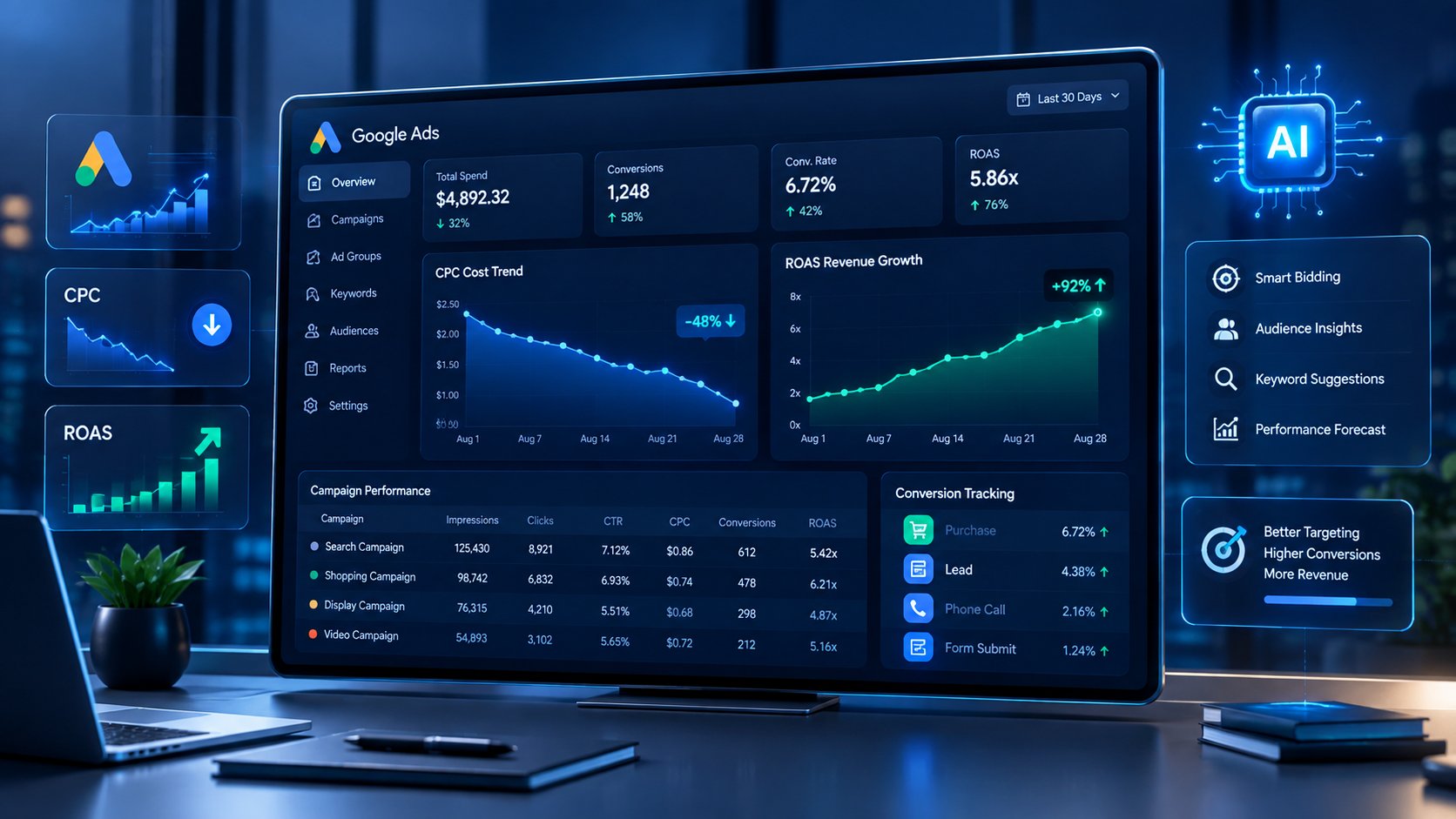
- Has your CPC increased? Check average CPC over the same period. If CPC has risen significantly, this alone can explain a ROAS decline even if everything else is constant. CPC increases are typically caused by increased competition in your auction, lower Quality Score, or broad match expansion triggered by algorithm updates.
- Has your conversion rate declined? Unchanged CPC but falling conversion rate points to a landing page issue, a product/offer issue, or a targeting drift — your ads are now reaching a less qualified audience than before.
- Has your traffic mix changed? Analyze performance by device, geography, and keyword to identify whether a specific segment has changed significantly. A sudden shift in mobile traffic volume, for example, can affect overall ROAS if mobile converts differently than desktop for your product.
- Has your competitive landscape changed? New competitors entering your category, existing competitors increasing their budgets, or changes in how competitors are bidding on your core keywords can all affect your ad position and your CPC simultaneously.
- Has something changed on your landing page? Even small landing page changes — a removed trust badge, a slower load time from a new plugin, a changed checkout flow — can produce meaningful conversion rate drops.
The Most Common ROAS Drop Causes
Based on patterns across many PPC accounts, the most frequent ROAS drop causes are: increased CPC from new or more aggressive competition, conversion rate decline from landing page changes, audience targeting drift from broad match expansion, seasonal demand shifts that change traffic quality, and Smart Bidding algorithm instability during learning periods following campaign changes.
Practical PPC Optimization Scenarios
Scenario 1 — New campaign with high CPC and low ROAS: For campaigns in early stages, the priority is establishing clean data. Add broad initial negative keyword lists, tighten match types from broad to phrase and exact on your core terms, and focus budget on your highest-priority keywords before expanding.
Scenario 2 — Established campaign with declining ROAS: Use the diagnosis framework above to identify the specific cause before making changes. Random optimization without diagnosis often makes things worse. Identify whether the issue is CPC, conversion rate, traffic mix, or competitive, then address the specific cause.
Scenario 3 — Amazon PPC with high ACoS: Amazon PPC optimization follows similar principles to Google Ads but with Amazon-specific mechanics. The ACoS equivalent of ROAS diagnosis involves checking search term reports for irrelevant traffic, reviewing bid competitiveness on your primary converting keywords, and ensuring listing conversion rate is strong enough to support PPC profitability. At Bizistech, Amazon PPC optimization is one of our core specializations — and the discipline of consistent search term analysis and negative keyword management is just as critical on Amazon as on Google.
Common PPC Optimization Mistakes
Optimizing based on click volume rather than conversion data. High-click keywords that do not convert should be reduced or paused, regardless of how much traffic they generate. Clicks without conversions are costs without revenue.
Making too many changes at once. When multiple variables change simultaneously, it becomes impossible to identify which change caused which outcome. A structured testing approach — change one variable at a time, wait for sufficient data, then evaluate — produces more reliable learning.
Pausing campaigns during Smart Bidding learning periods. After any significant campaign change, Smart Bidding enters a learning period during which performance can be temporarily erratic. Pausing and restarting campaigns during this period resets the learning process and creates the instability it was meant to resolve.
Ignoring impression share data. Low impression share on your best-performing keywords means you are winning auctions for those keywords less often than you could be — leaving revenue on the table. Before expanding to new keywords, ensure your best-performing ones have adequate impression share.
Treating optimization as a monthly activity. In competitive PPC environments, weekly optimization is the minimum standard. Markets shift, competitors adjust their strategies, and search behavior evolves in ways that monthly review cycles miss entirely.
Expert Tips for Sustained PPC Performance
Build optimization into a weekly routine, not an event. Set a specific day and time each week for search term report review, bid assessment, and performance analysis. Consistent weekly optimization compounds over time into significantly better account performance than sporadic intensive reviews.
Track micro-conversions alongside primary conversions. If your primary conversion is a purchase, also track add-to-cart, checkout initiation, and email signup. These micro-conversion signals help Smart Bidding algorithms optimize more effectively in accounts where final purchase volume is limited.
Segment your reporting before acting on it. Aggregate campaign metrics often hide important variance. Always analyze performance by device, geography, keyword, and audience before making optimization decisions based on overall numbers.
Document every significant change you make. A simple change log recording what changed, when, and why makes it significantly easier to diagnose performance changes later. This is particularly important in accounts managed by multiple people.
Connect PPC data to your actual business economics. The ultimate measure of PPC performance is whether your campaigns are contributing to profitable business growth — not whether they achieve a specific ROAS number. Understanding your cost of goods, customer lifetime value, and profit margin allows you to set PPC targets that reflect business reality rather than arbitrary benchmarks.
Frequently Asked Questions About PPC Optimization
What is PPC optimization?
PPC optimization is the ongoing process of improving paid advertising campaign performance by reducing wasted spend, improving ad quality, refining targeting, and increasing conversion rates. The goal is to generate more return — more revenue, leads, or conversions — from each dollar of advertising budget spent.
How do I lower my CPC in Google Ads?
The most effective ways to lower CPC in Google Ads are improving Quality Score (which directly reduces the cost per click through Google’s auction mechanics), tightening campaign and ad group structure to improve ad relevance, using more specific match types to reduce irrelevant traffic, and consistently adding negative keywords to prevent budget waste on non-converting searches.
What is a good ROAS for PPC campaigns?
A good ROAS depends on your profit margins. Calculate your minimum breakeven ROAS by dividing 1 by your gross margin percentage. A business with 30% gross margins needs a minimum ROAS of approximately 333% to break even on advertising. Most businesses target a ROAS well above breakeven to ensure advertising contributes positively to profit. Industry benchmarks from sources like WordStream suggest average ROAS varies significantly by industry, so internal benchmarks based on your own margins are more meaningful than industry averages.
How does Quality Score affect CPC?
Quality Score directly affects how much you pay per click through Google’s auction mechanism. Higher Quality Scores produce lower actual CPCs because Google rewards relevance — advertisers with highly relevant ads and landing pages can achieve the same ad position as higher-bidding competitors at a lower cost. A Quality Score improvement from 5 to 8 on the same keyword can produce a meaningful CPC reduction without any change in bid amount.
What are negative keywords and how do they help?
Negative keywords are terms you specify to prevent your ads from showing when those terms appear in a search query. They help by eliminating irrelevant clicks — visits from people who are not looking for what you sell — which reduces wasted spend, improves your campaign’s conversion rate, and often improves Quality Score by increasing the CTR of the remaining, more relevant traffic.
How often should I optimize my PPC campaigns?
Weekly optimization is the standard for competitive PPC environments. At minimum, search term reports should be reviewed and negative keywords added weekly. Bid adjustments, ad copy testing, and audience targeting refinements can be reviewed on a bi-weekly or monthly cycle depending on campaign volume and velocity of change.
Should I use manual or automated bidding?
The choice depends primarily on your conversion volume. Automated bidding strategies like Target ROAS and Target CPA work best when campaigns generate at least 30 to 50 conversions per month, giving the algorithm sufficient data to optimize effectively. Below those thresholds, manual bidding with careful human oversight typically produces more consistent results. Most experienced PPC managers use a hybrid approach — automated bidding supported by strong campaign structure and ongoing manual management of the structural and targeting factors the algorithm cannot optimize.
Why is my ROAS dropping?
ROAS drops are typically caused by one of several factors: increased CPC from heightened competition, declining conversion rate from landing page issues or audience targeting drift, changes in traffic mix across devices or geographies, or instability during Smart Bidding learning periods. Use a structured diagnosis approach — checking CPC trends, conversion rate trends, traffic mix changes, and landing page performance — before making campaign changes.
How does landing page quality affect PPC performance?
Landing page quality affects PPC performance in two ways. First, it directly influences your Quality Score’s landing page experience component, which affects your CPC. Second, and more importantly, landing page quality determines your conversion rate — which is a direct input to ROAS regardless of how well your ads perform. Poor landing pages waste the traffic good ads generate.
What is the fastest way to reduce wasted ad spend?
The fastest way to reduce wasted ad spend is systematic negative keyword management. Review your search term reports, identify queries that triggered your ads but do not match your product or service, and add them as negative keywords. This can produce immediate budget efficiency improvements — redirecting spend from non-converting searches to keywords more likely to generate conversions.
Final Takeaway — Build an Optimization System, Not a One-Time Fix
PPC optimization is not a campaign setting you configure once and leave. It is an operating discipline — a set of regular practices that, applied consistently over time, compound into significantly better performance than any single-session optimization effort can produce.
The hierarchy of impact runs roughly like this: campaign structure and Quality Score foundations create the conditions for efficiency; negative keyword management removes the waste; bid strategy and targeting refinements extract additional value from qualified traffic; and landing page optimization ensures that traffic converts at the rate the overall system needs to be profitable.
Whether you are managing Google Ads, Amazon PPC, or both, the principles are consistent: understand your specific economics, build clean campaign structures, eliminate irrelevant traffic systematically, test ad quality continuously, and ensure your landing pages convert the traffic your campaigns generate.
At Bizistech, PPC management is built around exactly these principles — applied consistently across every client account, every week. If your current campaigns are not performing at the level they should, the gap between where you are and where you could be is almost always an optimization gap, not a budget gap.
Ready to build a PPC program that actually delivers profitable returns? Get in touch with Bizistech today for a free PPC audit and a specific, honest assessment of where your campaigns’ biggest opportunities are.
Bizistech — PPC Optimization That Builds Profitable Campaigns, Not Just Impressive Dashboards.
