
If you’ve been advertising on Amazon, you’ve seen ACoS on the campaign dashboard and you know what it means. For some, working hard to reduce it is a source of pride. For others, it is a metric they monitor without a clue of its meaning or the actions to take in response to it.
At Bizistech, we take all our new clients’ ACoS numbers as our first talking point for their Amazon PPC Ads. After all, if you don’t understand this figure, you can’t control your advertising spends on Amazon. In this guide, we explain everything you need to know about Amazon PPC and ACoS. We define it, show you how to set your optimal levels, craft supporting tactics, and minimize it without stunting growth.
What Is Amazon PPC ACoS
Amazon PPC ACoS means Advertising Cost of Sale, which indicates how much of your sales attributed to a certain revenue spent on Ads. Simply put, ACoS shows what percentage of your sales revenue you spent on Ads.
To calculate ACoS, use the formula below:
ACoS = (Ads Cost / Revenue from Ads) x 100
If you spent $100 and made $500 in sales, then your ACoS is 20 percent. Assessing your ACoS is not as straightforward, however, and requires you to measure if 20 is a favorable number for your business.
A lot of sellers make the same mistakes. For example, if you read that a nice ACoS is 15 percent, and you find that your ACoS is 35 percent, then you have to self-reflect and see if that 35 percent is still profitable, 15 percent may be a lot for a product still ranking and selling. 35 percent ACoS may still be acceptable assuming margin remains healthy.
What Is a Good ACoS for Amazon PPC?
What a good ACoS for Amazon PPC is remains one of the most popular questions on Amazon forums. The truthful answer is that it is dependent on three factors: your product margin, your goals, and your growth stage.
Bizistech delineates this framework to define target ACoS for all of their clients.
Your starting point is your break-even ACoS. This is the point at which your ad spend equals your profit margin, and there is no profit to be made on any of the sales you have advertised. To calculate your break-even ACoS, take your profit margin after costs, excluding advertising. If you have a 35 percent margin before ad spend, then your break-even ACoS is 35 percent.
Your Target ACoS is what you truly want to achieve. For a campaign to be profitable, your ACoS must be greater than your break-even ACoS. If your break-even ACoS is 35 percent and you are at 22 percent, you are profiting per each sale that you have advertised.
Your Launch ACoS is a different story. When you are in a product launch phase, it is common to be at or greater than break-even ACoS, or even profitable. The benefit of your Ranked Position is greater than the cost of sales.
The phase that your business is in is important for interpreting your ACoS on PPC Amazon.
ACoS Amazon PPC Strategy: How to Actually Lower It
Now we will discuss a practical Amazon PPC acos strategy. We will show you how to reduce the acos with minimal impact to sales volume.
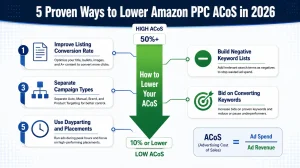
To reduce ACoS, improving listing conversion rates is the most commonly neglected strategy. Let’s say your listing is converting at 8 percent and you are able to get this conversion to 14 percent. The ACoS will drop without any bids changes. This improvement is due to more quality images, bullet points, captivating titles, and added A Plus content. Lowering the conversion is often a concealed reason for a high ACoS.
Wasted spend is one of the main causes for high ACoS, and building aggressive negative keyword lists can help combat this. Each dollar wasted, is a dollar the ACoS improves.
High ACoS and budget bleed are common when automatic and manual campaigns are not separated. For manual campaigns, Bizistech creates specific campaigns for auto targeting, broad matching, phrase matching, and exact matching. Each campaign has a unique budget and bid. This adds a layer of control when optimizing a campaign and helps determine where budget is allocated.
Let’s be more aggressive with our bidding on high converting keywords. Keywords don’t all perform the same. Find the search terms in your account that convert the best with the lowest ACoS, and increase the spend there. At the same time, decrease or pause the spend on the keywords that have a high number of clicks but low conversions. This spend adjustment will impact your overall ACoS.
Utilize dayparting and placement adjustments. Amazon allows you to modify your bids according to ad placements (top of search vs. rest of search vs. product pages) and time of day. Looking at which placements and which times work best for you and adjusting your bids for those placements and times will improve ACoS in your account, and is a more advanced adjustment to make.
The Best Amazon PPC Agency for Lowering ACoS
Finding the best amazon ppc agency for lowering acos means finding a team that understands ACoS not as a standalone number but as part of your overall profitability picture.
At Bizistech, our ACoS management approach starts with understanding your true margins — cost of goods, FBA fees, referral fees, and all other costs — before we ever set a target. From there we build a campaign structure and optimization schedule designed specifically to move your ACoS toward profitability while protecting the sales velocity your ranking depends on.
We do not chase artificially low ACoS numbers that look good on a report but actually slow your growth by cutting spend on campaigns that are building ranking momentum. We chase profitable, sustainable ACoS that reflects real business performance — and we communicate that difference clearly with every client from day one.
Our weekly reporting includes full ACoS breakdowns by campaign, ad group, and keyword — so you always know exactly where your money is going and exactly what it is returning.
If your Amazon ACoS is higher than it should be and you are not sure how to fix it, get in touch with Bizistech today. We will audit your account, identify the specific causes, and build a strategy to bring it down — with full transparency and no obligation.
Bizistech — Smarter Amazon PPC. Lower ACoS. Real Profit
