
A live Amazon listing and a well-optimized Amazon listing are not the same thing. Plenty of sellers have products listed, getting some traffic, and still underperforming — buried past page one for the terms that actually convert, or getting clicks that don’t turn into sales. That gap is what Amazon optimization services are built to close: targeted work on keywords, content, images, and conversion elements to make existing listings rank better and sell better, without necessarily taking over the whole account.
This guide explains what these services actually include, how they differ from broader account management or PPC management, how to tell whether your own listings need this kind of work, what it costs, and how to vet a provider. It’s written for sellers and brand managers who already have listings live and want to know whether optimization is the missing piece.
Quick Answer
Amazon optimization services focus on improving existing listings — keywords, titles, images, A+ Content, and conversion elements — to increase organic visibility and sales, usually delivered as a project or ongoing engagement separate from full account management or PPC advertising. They’re the right fit when listings are live but underperforming on ranking or conversion, not when the core issue is account health, inventory, or advertising strategy.
What Are Amazon Optimization Services?
Amazon optimization services are focused work on improving the content, structure, and presentation of existing product listings so they rank higher in Amazon search and convert more of the traffic they already get. The scope is narrower than full store management — it’s centered on the listing itself and the search visibility around it, rather than account health, inventory, or day-to-day advertising bid management.
Amazon’s search system rewards listings that match what shoppers are searching for and that convert once shown — relevance and performance both feed into ranking. Optimization work targets both sides of that: the keyword and content side (so the listing shows up for the right searches) and the conversion side (so the traffic that arrives actually buys). A listing can be technically live and still lose on both fronts if it was never properly optimized after the initial upload.
These services are offered by agencies, Amazon-focused consultancies, and specialist freelancers, sometimes as a one-time project (a full listing overhaul) and sometimes as an ongoing engagement with continued testing. Scope varies between providers, so it’s worth confirming exactly what “optimization” includes before comparing options — the next section breaks that down.
What’s Included in Amazon Optimization Services
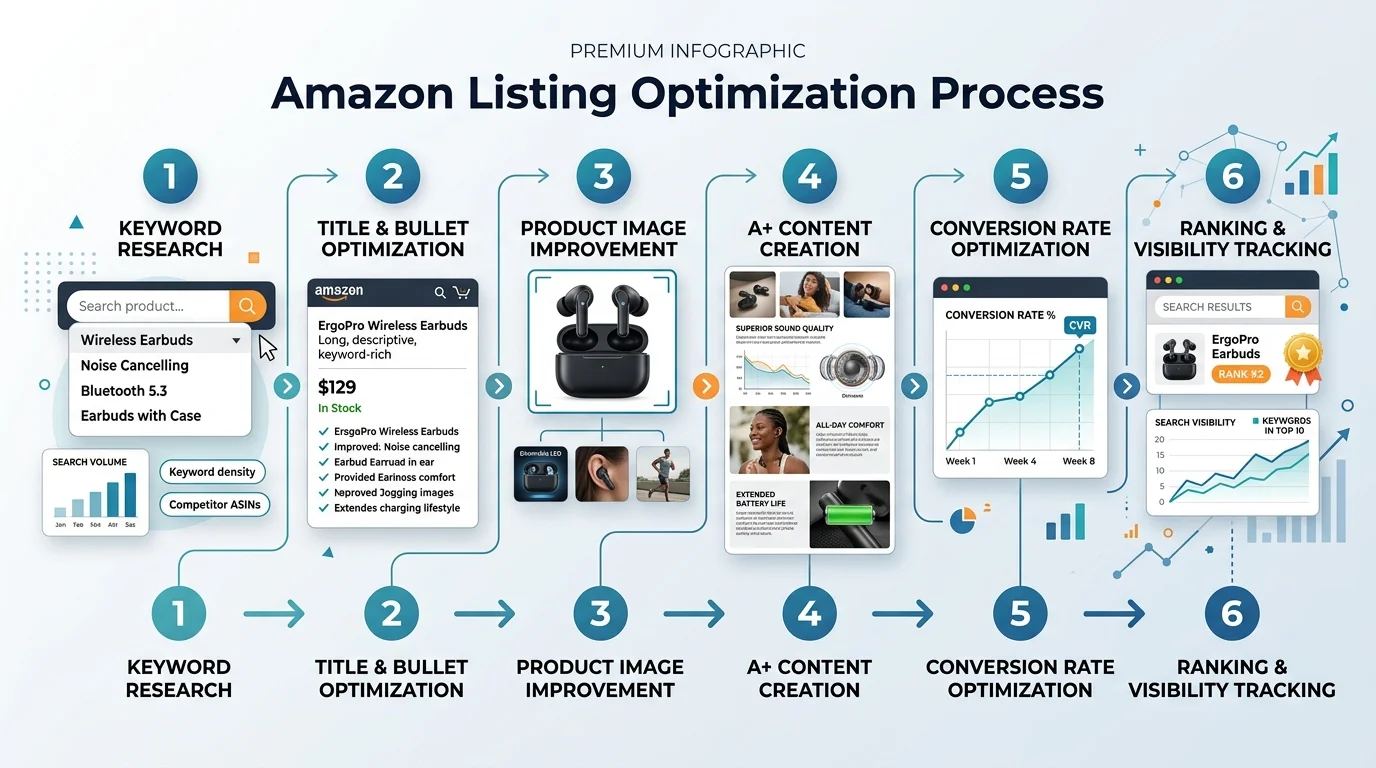
A thorough optimization engagement generally covers six core functions.
Keyword Research & Backend Search Term Optimization
This starts with identifying the terms shoppers actually search for the product, including competitor keywords the current listing is missing, and placing them across the title, bullets, description, and the hidden backend search term fields Amazon uses for indexing. Backend terms don’t show to shoppers but directly affect what searches the listing is eligible to appear in.
Title, Bullet Point & Description Optimization
Rewriting these elements to front-load the most important keywords and selling points, follow Amazon’s character and formatting guidelines, and communicate benefits clearly — not just list features. A common mistake here is writing for search engines only and losing the persuasive, benefit-driven language that actually drives a purchase.
Image & A+ Content Optimization
Main and secondary images, infographics, and comparison charts get reviewed and improved to increase click-through rate from search results and support conversion once a shopper lands on the page. For Brand Registry-enrolled sellers, this extends to A+ Content — the enhanced visual modules that replace the plain description.
Conversion Rate Optimization (CRO)
Beyond content, this covers structural elements that influence whether a visitor buys: pricing presentation, bullet order, addressing common objections directly in the copy, and sometimes recommendations around review generation strategy (within Amazon’s terms of service) since review count and rating both affect conversion.
Ranking & Visibility Optimization
This ties the keyword and content work back to actual search position — tracking where the listing ranks for its target terms before and after changes, and adjusting based on what’s actually moving versus what isn’t.
Ongoing Testing & Iteration
For providers offering optimization as an ongoing service rather than a one-time project, this means testing image order, title variations, or A+ Content layouts against performance data over time, rather than treating the initial optimization as a permanent, finished state.
Amazon Optimization vs. Store Management vs. PPC Management
These three service categories overlap in marketing language but cover different scope, and mixing them up is a common source of mismatched expectations.
| Service | Core focus | Typical engagement |
| Amazon optimization | Listing content, keywords, images, conversion elements | Project-based overhaul, or ongoing testing and refinement |
| Amazon store/account management | Full account oversight — account health, inventory, listings, advertising, reporting | Ongoing monthly retainer covering multiple functions at once |
| Amazon PPC management | Sponsored Products, Sponsored Brands, and Sponsored Display campaigns specifically | Ongoing, since bids and budgets need regular adjustment |
In practice, optimization and PPC management work best together — a well-optimized listing converts better once ads send it traffic, and ad data itself often reveals which keywords are worth optimizing the listing content around. Full store management typically includes optimization as one component alongside the others, which is why some sellers who think they need “optimization” actually need broader account management, and vice versa.
Signs Your Listings Need Optimization
A few patterns tend to indicate an optimization problem specifically, rather than a pricing, inventory, or advertising issue.
- Impressions and clicks are reasonable, but conversion rate is noticeably lower than similar products in the category.
- The listing doesn’t appear for obvious, high-relevance search terms that competitors rank for.
- Images look dated, are hard to read at thumbnail size, or don’t communicate key product benefits at a glance.
- The listing was set up once at launch and hasn’t been revisited despite competitor listings clearly evolving since.
- PPC campaigns are running and getting clicks, but sales aren’t following — often a sign the listing itself, not the ads, is the bottleneck.
- Backend search terms were never filled in, left mostly empty, or still contain terms from an early, less-refined version of the listing.
How to Choose an Amazon Optimization Service
Once it’s clear optimization is the right category of help, a few checks help separate a credible provider from one selling vague promises.
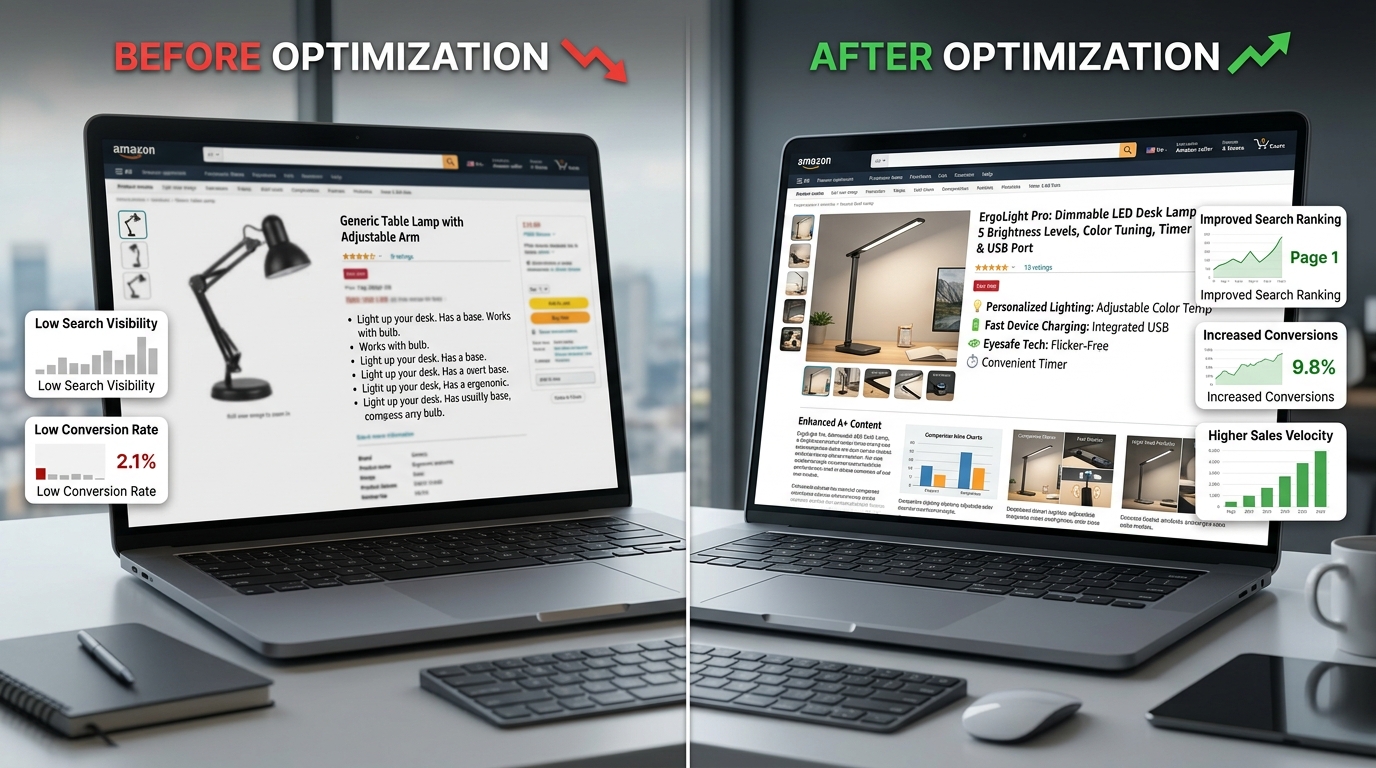
Ask to See Before/After Listing Examples
A provider with real experience should be able to show actual listing changes they’ve made — not necessarily sales results (which depend on many factors), but concrete examples of how they restructure titles, bullets, and images.
Understand What Gets Tested and How
Ask specifically what’s tested (images, titles, A+ layouts), how long each test runs, and what data determines a winner. A provider that can’t describe a process is likely applying generic templates rather than working from performance data.
Confirm Reporting Ties Back to Metrics, Not Just Deliverables
A list of “we rewrote your title and uploaded new images” isn’t the same as reporting on whether CTR, conversion rate, or ranking actually moved. Ask what metrics will be tracked before and after the engagement starts.
Watch for Guaranteed-Ranking Red Flags
No legitimate provider can guarantee a specific search ranking or sales increase — Amazon’s algorithm weighs many factors outside any single provider’s control, including competitor activity and pricing. Reasonable providers describe their process and typical timelines instead of promising outcomes.
Other red flags worth watching for: Amazon optimization services
- Pricing based purely on “per listing” with no clarity on what’s actually changed for that price.
- No willingness to share a sample of past optimization work.
- Copy-paste templates that ignore category-specific search behavior.
- Pressure to bundle in unrelated services (like full PPC management) before the optimization scope is even defined.
Amazon Optimization Pricing Models
Pricing generally falls into one of three structures.
- Per-listing project fee — a flat, one-time cost to fully optimize a single listing (title, bullets, backend terms, images, and A+ Content where applicable).
- Catalog-based package pricing — a bundled rate for optimizing a set number of listings at once, common for sellers with many SKUs needing a refresh together.
- Ongoing retainer — monthly pricing for continued testing and iteration rather than a single overhaul, often paired with reporting on ranking and conversion trends over time.
There’s no single standard price across the industry, since scope (number of listings, whether A+ Content and photography are included, category complexity) varies widely between engagements. The more useful question to ask a provider is exactly what elements are covered in a given price, rather than comparing a single number across providers.
Practical Examples: What Optimization Looks Like in Practice
A listing with strong traffic but weak conversion
For a listing bringing in clicks through PPC but converting below category average, optimization work would typically start with the images and bullet points — since traffic clearly isn’t the problem, the listing itself likely isn’t closing the sale once a shopper lands on it.
A listing that barely shows up in search at all
This points more toward keyword and backend search term work — in practice, a common cause is a listing that was launched with a thin, generic title and empty backend fields, so it’s simply not indexed for the terms shoppers are actually using.
A catalog of 30+ SKUs, none updated since initial launch
At this scale, a catalog-based package engagement is usually more practical than optimizing listings one at a time, since competitor research and category-level keyword patterns can be reused across similar products in the same catalog.
Common Mistakes Sellers Make
- Assuming poor sales are always an advertising problem and skipping listing optimization entirely.
- Optimizing once at launch and never revisiting the listing as competitors update theirs.
- Leaving backend search terms empty or filled with outdated, unrefined keywords.
- Choosing a provider based only on price per listing without confirming what’s actually included.
- Expecting a ranking jump within days — Amazon’s algorithm needs a sales and engagement history to respond to changes, which takes time.
Expert Tips for Getting More From an Optimization Engagement
- Share actual customer questions and objections (from reviews or customer service) so the provider can address them directly in the copy, not just keywords.
- Run optimization and PPC data together where possible — search term reports from advertising often reveal exactly which keywords are worth prioritizing in the listing.
- Set a baseline before work starts (current ranking, CTR, conversion rate) so improvement is measurable rather than assumed.
- Revisit optimized listings periodically rather than treating the work as permanently finished — competitor listings keep changing, and so should yours.
Frequently Asked Questions
What are Amazon optimization services?
Amazon optimization services improve existing product listings — keywords, titles, bullet points, images, A+ Content, and conversion elements — to increase organic search visibility and sales, without necessarily managing the whole account.
How is Amazon optimization different from Amazon SEO?
They largely overlap. “Amazon SEO” usually refers specifically to the keyword and ranking side, while “optimization” is often used more broadly to include images, A+ Content, and conversion elements alongside the SEO work. Ask a provider directly what’s included under either label.
How much does Amazon listing optimization cost?
Pricing depends on scope — whether it’s a single listing or a full catalog, and whether photography or A+ Content is included. Providers typically charge a flat per-listing project fee, a bundled catalog package rate, or an ongoing monthly retainer for continued testing.
How do I know if my Amazon listings need optimization?
Common signs include low conversion rate despite decent traffic, not ranking for relevant search terms, outdated images, empty or unrefined backend search terms, or a listing that hasn’t been updated since it first launched.
Can listing optimization alone fix low sales?
It depends on the underlying cause. Optimization helps when the problem is visibility or conversion related to the listing itself, but it won’t fix issues like uncompetitive pricing, insufficient reviews, or an account health problem — those need separate attention.
Does optimization guarantee a higher search ranking?
No. Ranking depends on multiple factors including competitor activity, pricing, and sales history, none of which any single provider fully controls. A provider promising a guaranteed ranking outcome is a red flag worth questioning.
How long does it take to see results from listing optimization?
Amazon’s algorithm needs a period of sales and engagement data to respond to listing changes, so meaningful ranking or conversion shifts typically take several weeks to become clear rather than appearing immediately.
Do I need Brand Registry for full optimization services?
No, core optimization work like keywords, titles, and images doesn’t require Brand Registry. Brand Registry is needed specifically for A+ Content, so a provider offering that particular element will need the account enrolled.
Is Amazon optimization a one-time project or an ongoing service?
Both models exist. A full listing overhaul is often delivered as a one-time project, while continued testing and iteration — refining images, titles, or content based on performance data over time — is typically offered as an ongoing retainer.
What’s the difference between optimization and full store management?
Optimization focuses specifically on listing content and conversion elements. Full store management is broader, typically including account health monitoring, inventory coordination, and advertising management alongside optimization as one component of the overall service.
Final Takeaway
Amazon optimization services exist for a specific gap: listings that are live but not performing the way they should, whether that shows up as weak conversion, poor ranking, or both. The work centers on keywords, content, images, and conversion elements — narrower than full account management, but often the exact fix when advertising and inventory aren’t the issue.
Before hiring a provider, get clarity on exactly what’s included at the quoted price, ask to see real examples of past work, and treat any guaranteed-ranking promise as a reason to look elsewhere rather than a selling point. A provider that explains its testing process and ties results back to actual metrics is generally the safer choice over one selling a fixed “optimization package” with no visibility into what changes.
