
In 2026, Amazon remains the world’s largest e-commerce marketplace — and choosing between FBA and FBM is still one of the most critical decisions for any Amazon seller.
With Amazon increasing FBA fees, storage limits tightening, and more sellers adopting a hybrid approach, the answer is no longer black and white. This guide breaks down everything you need to know.
1. What is Amazon FBA?
Fulfillment by Amazon (FBA) means you send your inventory to Amazon’s warehouses, and Amazon handles everything — storage, packing, shipping, customer service, and returns.
How it works:
- You ship products to Amazon’s fulfillment center
- Amazon stores your inventory
- Customer places an order
- Amazon picks, packs and ships the order
- Amazon handles returns and customer service
FBA products are also eligible for Amazon Prime, giving them a massive visibility advantage. In 2026, over 200 million Prime members worldwide filter specifically for Prime-eligible products.
2. What is Amazon FBM?
Fulfillment by Merchant (FBM) means you list your products on Amazon, but you store, pack, and ship orders yourself or through a third-party logistics provider (3PL).
How it works:
- Customer places an order on Amazon
- You receive the order notification
- You pack and ship from your own warehouse or 3PL
- You manage returns and customer service
FBM gives you full control over inventory, packaging, and fulfillment costs. Top-rated FBM sellers can qualify for Seller Fulfilled Prime (SFP), unlocking the Prime badge without using Amazon’s warehouses.
3. FBA vs FBM – Pros & Cons
FBA – Pros
- Prime badge = more sales and visibility
- Amazon handles all logistics end-to-end
- 24/7 customer service handled by Amazon
- Easier to win the Buy Box
- Scale without needing warehouse space
- Multi-channel fulfillment available
FBA – Cons
- High and increasing fees in 2026
- Long-term storage fees on slow-moving products
- Less control over packaging and presentation
- Inventory limits and restock restrictions
- Commingling inventory risks with other sellers
- Harder to manage returns abuse
FBM – Pros
- Full control over inventory and branding
- Lower fees for large or heavy products
- No storage fees paid to Amazon
- Custom packaging allowed
- Better profit margins on low-competition items
- SFP option available to earn the Prime badge
FBM – Cons
- Must manage shipping and returns yourself
- Harder to win Buy Box without SFP
- No automatic Prime badge
- Requires warehouse space or 3PL setup costs
- More day-to-day operational work
- Customer service is entirely your responsibility
4. Side-by-Side Comparison (2026)
| Factor | FBA | FBM | Winner |
| Prime Eligibility | Automatic | Only via SFP | FBA |
| Buy Box Advantage | Strong | Moderate (SFP = equal) | FBA |
| Fulfillment Cost | Higher fees | Lower if efficient | FBM |
| Storage Cost | Monthly Amazon fees | Your warehouse / 3PL | Depends |
| Scalability | Very easy | Requires more setup | FBA |
| Branding | Limited | Full control | FBM |
| Customer Service | Handled by Amazon | You handle it | FBA |
| Large / Heavy Items | Expensive fees | Much cheaper | FBM |
| Seasonal Products | Storage fee risk | No extra penalty | FBM |
| New Sellers | Easier to start | More setup needed | FBA |
| Profit Margins | Lower (more fees) | Higher potential | FBM |
| Returns Handling | Amazon manages | You manage | FBA |
5. Amazon FBA Fees in 2026
Amazon has consistently raised FBA fees. In 2026, sellers should expect the following charges:
Fulfillment Fees (per unit)
| Size Tier | Weight | Approx. Fee |
| Small Standard | Up to 4 oz | ~$3.22 |
| Large Standard | 1 – 2 lb | ~$5.40 – $6.20 |
| Large Bulky | Up to 50 lb | ~$9.73 – $16+ |
| Extra-Large | 50 – 150 lb | ~$26 – $89+ |
Storage Fees (per cubic foot / month)
| Period | Standard Size | Oversize |
| January – September | ~$0.78 | ~$0.56 |
| October – December (Peak) | ~$2.40 | ~$1.40 |
2026 Key Change: Amazon introduced a new low-inventory fee for FBA sellers who don’t maintain at least 28 days of supply. Keep inventory topped up — or switch some products to FBM to avoid this penalty.
6. Who Should Choose Which?
Choose FBA if you…
- Sell small, lightweight products
- Want passive, hands-off selling
- Are a new seller learning the platform
- Need the Prime badge for competitive niches
- Have high-turnover, fast-moving inventory
- Want to scale quickly without logistics headaches
- Plan to sell internationally via FBA Global Export
Choose FBM if you…
- Sell large, heavy, or bulky products
- Have your own warehouse or a reliable 3PL
- Sell slow-moving or seasonal products
- Want full control over branding and packaging
- Have very thin margins where every dollar counts
- Sell custom or handmade items
- Already have an efficient logistics operation
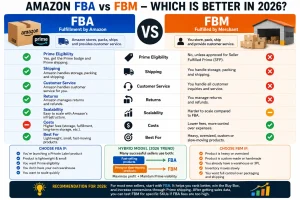
Hybrid Strategy (Best of Both Worlds)
In 2026, the smartest Amazon sellers use a hybrid FBA + FBM approach:
- Use FBA for fast-moving, Prime-sensitive products
- Use FBM as a backup when FBA inventory runs out
- Use FBM for heavy or oversized products to avoid excessive FBA fees
- Use FBA for competitive niches where the Prime badge is essential
Pro Tip: List every FBA product as an FBM listing too (same ASIN, different merchant offer). If your FBA stock runs out, Amazon will auto-route to your FBM listing — keeping sales alive 24/7.
7. Final Verdict – 2026
There is no single winner. The right choice depends entirely on your products, margins, and business goals.
FBA is better for most new sellers and those with fast-moving, lightweight products who want to scale without operational headaches.
FBM is better for experienced sellers with heavy products, slim margins, or those who want full control of their brand experience.
Hybrid is the gold standard — use FBA for its Prime advantage and FBM as a cost-efficient backup or for specific product categories.
8. Frequently Asked Questions
Q: Is FBA still worth it in 2026 with rising fees?
Yes, for most sellers FBA is still worth it — especially for small, fast-moving products in competitive niches where the Prime badge drives significantly more conversions. However, calculate your margins carefully with updated 2026 fees, and consider FBM for heavier or slower-moving items.
Q: Can I use both FBA and FBM at the same time?
Absolutely. This is called a hybrid fulfillment strategy. You can list the same product under both FBA and FBM on the same ASIN. This protects you from stock outs and lets you optimize cost vs. visibility for different products.
Q: What is Seller Fulfilled Prime (SFP)?
Seller Fulfilled Prime allows FBM sellers to display the Prime badge by meeting strict Amazon delivery standards — 1-day or 2-day delivery, high on-time shipment rate, and low cancellation rate.
Q: Which is better for beginners — FBA or FBM?
FBA is generally recommended for beginners because Amazon handles the complex logistics, customer service, and returns. This lets you focus on product research, listings, and marketing while you learn the platform.
Q: What products should NOT use FBA?
Heavy or bulky items, slow-moving seasonal products, very low-margin items, and custom or handmade products are usually better off with FBM due to excessive FBA fees and storage costs.
